Will our government implement make in India Scheme in Rare Earth field to convert the 90% world reserve as dollar?

‘Advanced research in rare earths need of the hour’

They are classified as strategic and critical materials

Chairman of the Indian Rare Earths Limited D. Singh on Sunday said due to fierce competition among global consumer electronics giants to have qualitative superiority, it had led to a situation of supply scarcity and precipitation ever since the Chinese domination in the field of research and development.

In his inaugural address at the International Conference on Science, technology and applications of rare earths (ICSTAR 2018) organised by the Rare Earths Association of India in Tirupati, Dr. Singh said the piquant situation had led to a rat race among stakeholders in rare earths for commissioning various projects. However, only a few greenfield projects had fructified. “Rare earths have been classified as strategic and critical materials by countries like America, China, Japan and South Korea. The worldwide production during 2017 is estimated at 1.6 lakh tonnes, as against the crude steel production of 1691.2 million tonnes, making the former miniscule.”

Dr. Singh said in view of the importance and inevitability of rare earths in day to day life, but with low levels of exploration, the need of the hour was to ground advanced research, development projects and production plants across the globe. It would create an environment where tendency of guarding the technology developed and acquisition of commercial scale technology would become difficult. “All stakeholders need to put in their efforts to bolster research and development, particularly the scientific community and the government to explore possibility of extending incentives akin to renewable energy,” Dr. Singh said.

Secretary of REAI Dr MLP Reddy, ICSTAR 2018 Chairperson Prof CK Jayasankar, senior scientists from all over India were present. The technological and scientific sessions would be held till September 25.

Source : https://www.thehindu.com/news/cities/Vijayawada/advanced-research-in-rare-earths-need-of-the-hour/article25023238.ece

Treasure washed away to Sri Lanka

The ban on beach sand mining, apart from creating pains to many sectors, has not helped the country gain anything. In fact, somebody else is enjoying the benefits. The immediate beneficiary is Sri Lanka, our tactful island neighbor.
It seems Sri Lanka gains from every Indian move… deliberate or otherwise. Modi who may stand tall alongside his western counterparts has to bend himself before the Buddhist monks of Srilanka being fully aware of the power they wield with the Island’s government. He may directly offer the Sri Lankans many goodies to lure them away from the Chinese advances. He would not have guessed the benefits Srilanka is reaping from the ban on Beach mining along the Tamilnadu coast. It is not just Sri Lanka, but the mining giant Iluka Resources from Australia who is another major beneficiary.
The ban of Placer sands along the TN coasts was imposed in September 2013 around the same time (August 2013) when Iluka Resources, Australia acquired the ‘Tenement and Heavy-mineral resource Base’  owned by  PKD Resources (Pvt) Ltd of Srilanka in Puttalam district. It was reported in the press that some 4.6 Million USD was spent on the purchase of the deposits.
Iluka Resources is not new to Sri Lanka. They were mining Beach Sands in the Island long since but left the country in 2003 citing two reasons. The company (when leaving in 2003) said that it is relinquishing its exploration leases because the quality of resources was poor and because of ‘accessibility’ issues.
What made Iluka return to Sri Lanka in 2013? The “accessibility issues” has been obviously solved with the end of the war. But how did the quality of the resource improve automatically? It is the new place Puttalam that has attracted the Mining Giant. Puttalam Quarry Deposits are located in the Northwestern Province of SriLanka, 170 Kilometers north of the Capital Colombo. The resource base is located diagonally opposite to the coasts of TN where most of the Placer mining was earlier taking place. By imposing the ban,  it seems India has knowingly or unknowingly have helped Sri Lanka et al.
Although Iluka Resources has acquired the resource tenements at Puttalam, way back in 2013, it did not start the mining operations probably, again for two new reasons.
One… To wait and watch whether the ban along the TN coast will continue.
Two… The expected elections and change of guard in Sri Lanka.
Both of the above concerns are now in favor of the mining company and now they are ready to start mining placer sands from Puttalam mines. The exploration/ mining operations are to start at the  Puttalam Quarry Deposits mentioned earlier. Again looking back at Iluka’s two main concerns the second concern is straightforward and understandable. It is political in nature. The Company came back in 2015 and negotiated with the new Government in Sri Lanka. It seems they have come to an understanding with the Government, as reported in many sections of the Sri Lankan Press.
Their first concern is more intriguing and requires some understanding of mineral geology.
Garnet, Ilmenite, and Rutile like minerals are found in hard rocks and are formed due to various geological processes over long times. Apart from the natural processes of the sun, wind, and rains, the rivers that flow through the rocks erode them to form sand sediments. The sediments are carried by the flowing river into the ocean. The mineral enriched sand gets dumped at the seashore known as the trap site.
The sand thus accumulated at the shore drifts along the beach to new coastal areas due to a process known as Longshore Drift (See image above). Longshore Drift happens mainly due to (oblique) wave action on the shores. When the volume of removal from the trap site is not huge, the mineral accumulates at the shores to form sustainable concentrations. It is this sand, mankind mines in the name of placer sand or beach mineral sand.
The sand thus accumulated at the shore drifts along the beach to new coastal areas due to a process is known as Longshore Drift (See image above). Longshore Drift happens mainly due to (oblique) wave action on the shores. When the volume of removal from the trap site is not huge, the mineral accumulates at the shores to form sustainable concentrations. It is this sand, mankind mines in the name of placer sand or beach mineral sand.
The picture becomes even more interesting with the presence of Adam’s bridge or Rama Sethu the submerged land bridge between India and Sri Lanka. The Longshore drift happens along Adam’s bridge and the mineral sands reach Sri Lankan Shores. This is particularly the case with Puttalam coasts of Sri Lanka. The Tamilnadu coast, the Adams bridge and the North-West coast of Sri Lanka forms a bay where sands drift with utmost speed. When you do not mine the sands here in India the sands will eventually reach Sri Lankan coasts where they are going to mined (See Figure above).  This is how the ban here has helped Sri Lanka to reopen the mining operations.
Placer sands are totally replenishable and bring in huge benefits to the country in terms of direct revenues and employment. The Beach sand, according to the available composition is segregated into minerals like Ilmenite, Zircon, Garnet, Rutile, Leucoxene that are useful in making Paints, Ceramics, and abrasives apart from feeding many other industries.
If the ban was to prevent some private players becoming rich, what is preventing the governments to do the mining? But a natural question will spring up. When the government is privatizing critical sectors like Railways and even Military production why they should shy away from privatizing Beach mining? The governments have to be careful in monitoring the private parties in terms of royalty collection, handling of radioactive minerals, and damage to the environment. Instead of bowing to pressure from vested interests and squarely imposing a ban we must have a pragmatic look at the global picture and decide.
Iluka has pointed to huge employment, Economic growth and indirect growth of other industries in Sri Lanka that will come with the beach sand mining. So it goes without saying India loses employment, revenues, and allied Industrial growth. Sri Lanka knows India is always ready to shoot itself in the foot to charm its neighbor but India has also got to see what it loses in the task.
Source : https://responsiblemining.in/2018/05/30/treasure-washed-away-to-sri-lanka/

Govt reimposes curbs on beach sand mineral exports

Govt reimposes curbs on beach sand mineral exports

Exactly 20 years after it opened the door for the private sector in beach sand mining, the government has now taken away their right to export minerals on their own through a gazette notification and introduced a canalisation system.

Beach sand minerals and their derivatives find diverse applications in paints and other decorative materials, papers and plastics as well as strategic and hightech applications.

Exactly 20 years after it opened the door for the private sector in beach sand mining, the government has now taken away their right to export minerals on their own through a gazette notification and introduced a canalisation system. Players in the sector called the policy “myopic” and said their exports — Rs 4,000 crore per annum — will be hit hard.


The primary aim of canalisation of exports through Indian Rare Earths (IRE), is to curtail direct private sector export of beach sand minerals and their derivatives such as ilmenite, rutile and zircon, thereby keeping a close tab on shipments.

Beach sand minerals and their derivatives find diverse applications in paints and other decorative materials, papers and plastics as well as strategic and hightech applications. Currently, a major share of domestic production as well as exports are done by private sector firms.

“Export of beach sand minerals have been brought under the STE and shall be canalised through IRE. Beach sand minerals, permitted anywhere in the export policy, will now be regulated in terms of the new policy,” the notification said.

Private sector firms such as VV Minerals and Trimex, which do the bulk of exports, said the move would have far-reaching negative impact on the country’s beach sand minerals industry. Apart from coordination-related problems with IRE, the apprehension of untimely and irregular payment is also haunting them.

“The new policy to canalise all exports by private companies through IRE is a further blow to private companies. Private firms have made huge capital investments by way of technology, production facilities and established significant share in global markets. IREL is a competitor, and forcing private firms to canalise exports through IREL is an unfair business practice,” said V Subramanian, director of VV Mineral.

The ‘myopic’ policy will choke the sector which has the potential to transform India to a major global producer of high value products, he said. Since all minerals will be canalised through IRE, the PSU will remain the only touch point for overseas customers and this will erode the existing customer base that private sector firms have created over the years.

“The new policy comes as a huge setback to a niche beach sand mining industry. It increases our unease of doing business by rendering us globally uncompetitive, limits our abilities to bargain with global customers, binds us in potentially avoidable procedural delays and puts curbs on our expansion plans by throttling commercial activities,” said Pradeep Koneru, CEO & ED, Trimex Industries.

Beach sand minerals mining activity in India commenced in 1908. Until 1998, except for garnet, other minerals were restricted only to public sector companies. Production and value addition improved following the government ushered in liberalisation in 1998 allowing participation of the private sector.

Following the entry of the private sector, production of ilmenite and rutile increased to 5.2 lakh tonne and 72,000 tonne, respectively, in 2015-16. In sync with the rise in production, the export value has increased from approx Rs 35 crore in 1998 to over Rs 4,000 crore in 2016-17.

Source : https://www.financialexpress.com/industry/govt-reimposes-curbs-on-beach-sand-mineral-exports/1295666/


India makes tentative moves towards single tax rate for mining sector

 India’s Steel Ministry has made the first tentative move towards achieving a single unified tax for the mining industry, subsuming the plethora of taxes currently payable by miners.

Ministry officials acknowledged that the goal of having a single rate of tax for the mining industry would be protracted, considering that several of the levies, including royalties, accrued to the kitty of state governments and that all mineral-rich states would have to be brought on board if a single rate of tax on minerals was to be evolved under the Goods and Service Tax (GST), the unified indirect tax regime introduced across the country last year.

However, the official said that the plan to move towards a single tax rate could start with iron-ore mining, wherein iron-ore was taxed at 5% and finished steel at 18%. The option could be explored in related mining taxes, like royalties subsumed in the GST rate, and enable the entire chain from raw material to finished steel to claim input credit at every stage of value addition.

The Steel Ministry will prepare the draft proposal to be submitted to the department of revenue under the Finance Ministry, but the final decision would rest with the GST Council, the apex body of federal and state government representatives governing the GST regime.

The challenge before such a reform for the mining sector would be that, while the total tax incidence on the miningindustry might not be lowered, the adjusting multiple taxes into a single rate and shift of accruals from the state government to the federal government could lead to a loss or revenue for state governments. The federal government would have to make provisions to compensate state governments for such a loss, officials said.

The net effective rate on mining, which amounted to about 64% in the case of mines allocated prior to 2015 through preferential allotment and 60% for mines allocated through the auction route thereafter, comprised royalties, contributions to District Mineral Fund (DMF) and National Mineral Exploration Trust besides the GST rate as applicable, making Indian mining industry one of the highest taxed in the world.

Officials said that while the aim of a single rate of tax on mining would not be to bring down the net effective rate of tax, a single rate would ensure lower compliance costs for miners and offer the option of claiming input tax credit from their buyers across the production chain.

Source : http://www.miningweekly.com/article/india-makes-tentative-moves-towards-single-tax-rate-for-mining-sector-2018-07-27

தாது மணல்களின் இருப்பு விபரம்

Govt had this to say on atomic minerals and their mining

Atomic Minerals Directorate for Exploration and Research (AMD), a constituent unit of Department of Atomic Energy (DAE), has the mandate to identify, evaluate and augment mineral resources of uranium, thorium, niobium

Government of India is aware of the fact that 10.98 million tonnes of resources of Molybdenum Ore is located in Tamil Nadu. However, Department of Atomic Energy (DAE) has not taken up any project for exploitation of Molybdenum available near Harur Taluk, Dharmapuri District in Tamil Nadu.


Atomic Minerals Directorate for Exploration and Research (AMD), a constituent unit of Department of Atomic Energy (DAE), has the mandate to identify, evaluate and augment mineral resources of uranium, thorium, niobium, tantalum, beryllium, lithium, zirconium, titanium, rare earths (containing uranium and thorium) besides beach sand minerals like garnet and sillimanite [Atomic Minerals (Part B, First Schedule), The Mines and Minerals (Development and Regulation) Act, 1957].

During the last six and a half decades, AMD has identified adequate resources of atomic minerals in the country. The details of the resources of atomic minerals as on May, 2018 are furnished below:

Uranium –3,00,034 tonne uranium oxide (U3O8)


Beach Sand Minerals [BSM] – 1,173.07 million tonne.


The resources of the minerals comprising BSM are given below:

Thorium (as monazite) – 12.47 million tonne (1.12 million tonne ThO2)


The mineral monazite, containing ~ 55 – 60% total Rare Earth Elements (REE), is also the major resource for REE. AMD has also established ~ 2,000 tonne of ~2% xenotime (yttrium + REE mineral) – bearing heavy mineral concentrate.

Titanium (as ilmenite, leucoxene and rutile) – 682.30 million tonne


Zirconium (as zircon) – 35.75 million tonne


Garnet – 187.46 million tonne


Sillimanite -255.09 million tonne

The mining lease deed between the applicant and the State Government is executed by the respective State Governments subject to production of approved mining plan and other statutory permissions issued by various Government Departments. At present, uranium deposits established by AMD are mined by Uranium Corporation of India Limited (UCIL), a PSU of DAE. In respect of beach sand minerals, the mining operations are being carried out by both PSUs and private entrepreneurs. In respect of other atomic minerals like beryl, columbite, tantalite, lepidolite etc., no specific mining operations are being carried out except their recovery as by-products incidental to prospecting operations.

This information was provided by the Union Minister of State (Independent Charge)

Development of North-Eastern Region (DoNER), MoS PMO, Personnel, Public Grievances & Pensions, Atomic Energy and Space, Dr Jitendra Singh in written reply to a question in Rajya Sabha today.


Source : https://www.clipper28.com/en/govt-had-this-to-say-on-atomic-minerals-and-their-mining/

http://pib.nic.in/newsite/PrintRelease.aspx?relid=181094

இந்திய தாது மணல் தடையால் ஆராய்ச்சியில் இறங்கிய ஜப்பான் உலகம் முழுவதற்கும் பல நூறு வருடங்களுக்கு வினியோகம் செய்வதற்கான கனிம இருப்பு இருப்பதை கண்டு பிடித்துள்ளது.

உலக இருப்பில் 35 சதவீத தாது மணல் இந்தியாவிடம் உள்ளது. தொழில் நுட்பம் மாறுவதற்கு முன்பு இவற்றை சுரங்கம் செய்து ஏற்றுமதி செய்து டாலராக்க வேண்டும் என இந்திய அரசு வர்த்தக துறை முயற்சி செய்து நடவடிக்கை எடுத்தது. துரதிஷ்டவசமாக தனிப்பட்ட காரணங்களுக்காக இந்திய தாது மணல் தொழில் தற்காலிகமாக நிறுத்தப் பட்டது. இதனால் தேவை ஏற்பட்டு ஜப்பான் அரசு தாது மணலுக்கு ஆராய்ச்சி செய்யும் போது அவர்களிடம் உலகத்திற்கு பலநூறு வருடங்களுக்கு சப்ளை செய்வதற்கு தேவையான இருப்பு இருப்பதை சமீபத்தில் கண்டு பிடித்துள்ளார்கள்.

விஞ்ஞான பூர்வ நடவடிக்கை இல்லாமல் தனிப்பட்ட விரோதங்களுக்காக இந்திய தாது மணல் தொழிலை நிறுத்தி வைத்தது இந்தியாவிற்கு மிகப்பெரிய இழப்பீட்டை ஏற்படுத்தி வைத்துள்ளது மட்டும் இன்றி தற்போது இந்தியாவிற்கு எதிராக மிகப் பெரிய போட்டியையும் உருவாக்கி விட்டது. தற்போதாவது அரசு விழித்துக் கொண்டு தாதுமணல் தொழிலுக்கு உள்ள இடையூறுகளை நீக்கி இந்தியாவின் வேலை வாய்ப்பையும் அந்நிய செலவாணி ஈட்டுவதையும் உறுதி செய்ய வேண்டும்.

Source : https://www.sciencealert.com/japan-just-found-a-semi-infinite-deposit-of-rare-earth-minerals


Japan Just Found a Huge Rare-Earth Mineral Deposit That Can Supply The World For Centuries

This could change the global economy.

JEREMY BERKE, BUSINESS INSIDER
16 APR 2018

Researchers have found a deposit of rare-earth minerals off the coast of Japan that could supply the world for centuries, according to a new study.

The study, published in the journal Nature on Tuesday, says the deposit contains 16 million tons of the valuable metals.

Rare-earth minerals are used in everything from smartphone batteries to electric vehicles. By definition, these minerals contain one or more of 17 metallic rare-earth elements (for those familiar with the periodic table, those are on the second row from the bottom).

These elements are actually plentiful in layers of the Earth’s crust, but are typically widely dispersed. Because of that, it is rare to find any substantial amount of the elements clumped together as extractable minerals, according to the USGS.

Currently, there are only a few economically viable areas where they can be mined and they’re generally expensive to extract.

China has tightly controlled much of the world’s supply of these minerals for decades. That has forced Japan – a major electronics manufacturer – to rely on prices dictated by their neighbour.

A new finding that could change the global economy

The newly discovered deposit is enough to “supply these metals on a semi-infinite basis to the world,” the study’s authors wrote in the paper.

There’s enough yttrium to meet the global demand for 780 years, dysprosium for 730 years, europium for 620 years, and terbium for 420 years.

The cache lies off of Minamitori Island, about 1,150 miles (1,850 km) southeast of Tokyo. It’s within Japan’s exclusive economic zone, so the island nation has the sole rights to the resources there.

“This is a game changer for Japan,” Jack Lifton, a founding principal of a market-research firm called Technology Metals Research, told The Wall Street Journal.

“The race to develop these resources is well underway.”

Japan started seeking its own rare-earth mineral deposits after China withheld shipments of the substances amid a dispute over islands that both countries claim as their own, Reuters reported in 2014.

Previously, China reduced its export quotas of rare earth minerals in 2010, pushing prices up as much as 10 percent, The Journal reports. China was forced to start exporting more of the minerals again after the dispute was taken up at the World Trade Organisation.

Rare-earth minerals can be formed by volcanic activity, but many of the minerals on our planet were formed initially by supernova explosions before Earth came into existence.

When Earth was formed, the minerals were incorporated into the deepest portions of the planet’s mantle, a layer of rock beneath the crust.

As tectonic activity has moved portions of the mantle around, rare earth minerals have found their way closer to the surface.

The process of weathering – in which rocks break down into sediment over millions of years – spread these rare minerals all over the planet.

The only thing holding Japan back from using its newly found deposit to dominate the global market for rare-earth minerals is the challenge involved in extracting them.

The process is expensive, so more research needs to be done to determine the cheapest methods, Yutaro Takaya, the study’s lead author, told The Journal.

Rare-earth minerals are likely to remain part the backbone of some the fastest-growing sectors of the global tech economy.

Japan now has the opportunity to control a huge chunk of the global supply, forcing countries that manufacture electronics, like China and the US, to purchase the minerals on Japan’s terms.

Mr.S.Vaikundarajan of VV Mineral Clarification about the false allegation was accepted by New Indian Express, Cochin and regretted for having carried a one sided report

Indian Express published one sided news for which Mr.S.Vaikundarajan of VV Mineral send clarification. It is available in http://www.beachminerals.org/clarification-mail-send-to-indian-express-about-their-one-sided-news-against-vv-mineral/ 

Thanks to New Indian Express, Cochin for  verifying the facts immediately and published the clarification next day on 21.03.2018  in their publication 6th page.

New Indian Express, Cochin issued the clarification and concluded that, We regret having carried a one sided report.

The details are given below.

http://epaper.newindianexpress.com/1587027/The-New-Indian-Express-Kochi/21032018#page/6/1 


விவி மினரல், வைகுண்டராஜன், தாது மணல் என திட்டமிட்டு பிரச்சாரம் செய்தது உள்நோக்கம் கொண்டது

அளவிற்கு அதிகமான நிலத்தடி நீரை உறிஞ்சி எடுப்பதால் தான் நன்னீர் கிடைப்பதில்லை. உண்மையை வெளிக்கொணர்ந்த டைம்ஸ் ஆப் இந்தியா. இதன் மூலம் தாது மணலுக்கும், வைகுண்டராஜன் மற்றும் விவி மினரல் நிறுவனத்திற்கும் எதிராக வேண்டும் என்றே ஊடகங்களாலும், போட்டியாளர்களாலும் பொய் பிரச்சாரம் செய்யப்பட்டுள்ளது என்பது நிரூபிக்கப்படுகிறது.

***********

Incursion of seawater into over-exploited aquifer robs ECR residents of fresh water

TNN | Mar 6, 2018, 01.57 PM IST
Incursion of seawater into over-exploited aquifer robs ECR residents of fresh water
CHENNAI: Excessive extraction of groundwater has stressed the aquifer running between Thiruvanmiyur and Muttukadu causing seawater intrusion in several residential pockets along East Coast Road.
The 20km-long southern coastal aquifer is a potential source of fresh water for local residents, but extraction of water from the interface zone, that comes below the fresh water zone, has made way for seawater. The result? Residents sinking borewells are drawing up saline water every day.Hydrogeologist J Saravanan said the aquifer was one of the healthiest in the suburbs. “But due to rapid urbanisation, groundwater is being extracted from the fresh water zone (and beyond). This aquifer runs parallel to the Buckingham Canal which carries only saline water. This could have probably led to seawater intrusion in several localities on the East Coast Road,” he said.

The aquifer is sandy in nature and gets replenished the during monsoon. “With the surface covered by concrete structures, the natural process of water recharge has been hindered,” Saravanan added.

Residents of East Coast Road said seawater intrusion affected the quality of groundwater. Reverse osmosis units have become common in many houses. Siva, president of Kapaleeswarar Nagar Residents Welfare Association at Neelankarai, said the total dissolved solids (TDS) in the groundwater have increased from 150 TDS to 800 TDS in the past five years in their locality. Siva said Metrowater too was drawing groundwater for supplying drinking in the neighbourhood. The association gets the water tested every month at a laboratory.

“We have already been hit by this over exploitation with all the 5000-odd residents in the area being forced to depend on water purifiers while using the groundwater,” he said.

Saravanan said water bodies along the East Coast Road should be conserved as they would act as a barrier against sea water intrusion. That will ensure that the groundwater gets recharged during monsoon, he said.

Source : https://timesofindia.indiatimes.com/city/chennai/incursion-of-seawater-into-over-exploited-aquifer-robs-ecr-residents-of-fresh-water/articleshow/63177283.cms


விவி மினரல், வைகுண்டராஜன், தாது மணல் என செய்யப்பட்ட பொய் பிரச்சாரம் உடைந்தது.

போதிய மழை இருந்து நிலத்தடி நீர் நிரம்பினாலும் கூட தாது மணல் சுரங்கம் எதுவும் இல்லாத பகுதிகளிலும் நிலத்தடி நீர் உபயோகிக்க தகுதி அற்றது. அதே நேரத்தில் தாது மணல் சுரங்க பகுதிகளில் நிலத்தடி நீர் எந்த பாதிப்பும் இல்லை. இந்த செய்தி தாது மணலுக்கும், வைகுண்டராஜன் மற்றும் விவி மினரல் நிறுவனத்திற்கும் எதிராக உள்ள பொய் பிரச்சாரத்தை வெளிச்சத்திற்கு கொண்டு வரவில்லையா!!!

*****************

Monsoon replenishes groundwater, but renders it unfit for consumption

TNN | Mar 6, 2018, 07.06 AM IST
Monsoon replenishes groundwater, but renders it unfit for consumption
CHENNAI: The northeast monsoon might replenish the city’s aquifers and bring relief to the residents till summer, but the rain seems to do little to improve the quality of groundwater.
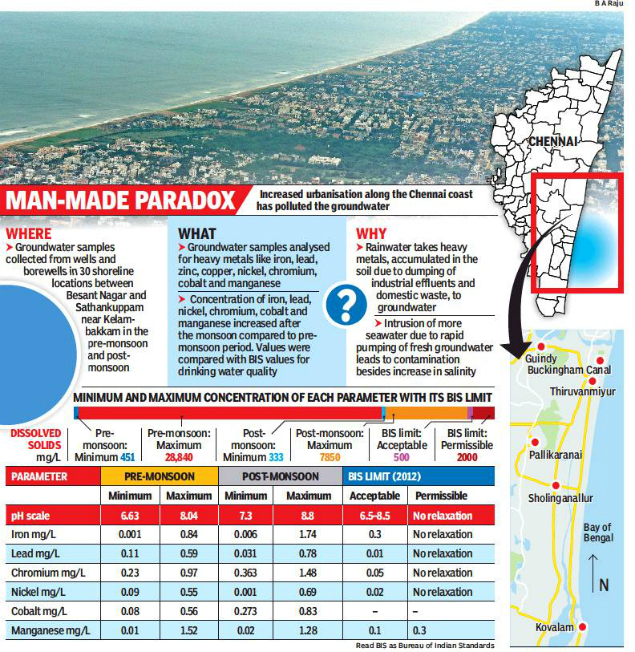
A joint study by researchers from University of Madras and Anna University shows that after the monsoon, concentration of heavy metals like lead, iron, chromium, nickel, cobalt and manganese increases beyond acceptable limits in the water table in localities between Besant Nagar in Chennai and Sathankuppam in Kancheepuram district.

mu9

Researchers compared groundwater samples collected before and after monsoon with Bureau of Indian Standards (BIS) drinking water values and inferred that the contamination of groundwater was due to the dumping of industrial effluents and domestic waste which seep into the aquifers along with rainwater. According to BIS, if the quantity of any metal in water is beyond the acceptable limit, the water is rendered unfit for consumption.

“The groundwater is contaminated due to rapid urbanisation which results in increase in industrial effluents and dumping of domestic waste,” the study said, adding that the effluent discharge accumulates heavy metals in the soil initially and later moves to the aquifers when the rainwater percolates.

The study, published in Springer’s journal Applied Water Science in September 2017, was conducted in an area of 270sqkm along the Bay of Bengal and covered Thiruvanmiyur, Pallikaranai marshland, Sholinganallur, Kovalam and localities close to Buckingham Canal and Muttukadu backwater.

Researchers collected 30 samples of water from

wells and borewells, and studied the presence of eight metals. The levels of six metals were high. “The study area has been rapidly urbanised over the past few decades. This has deteriorated the condition of the aquifers,” the study said.

Experts said toxic elements present in dumped waste were capable of seeping into the groundwater depending on permeability of the soil. In areas like Pallikaranai, dumping of waste causes leachate (liquid that drains from a landfill) to penetrate surface water and later into the groundwater. “It is similar to how water in the percolation pit or recharge well slowly takes it to the groundwater and then recharges wells. The quality of groundwater depends on the quality of the surface run off,” said J Saravanan, consultant hydro-geologist, Rain Centre.

The study found that concentration of iron in the groundwater could be due to corrosion and leaching from pipes while lead concentration could be due to plumbing material like pipes that react to the alkaline water. Chromium comes from dumping of municipal waste, nickel from sewage and corrosion of nickel alloy material, cobalt due to leaching from solid waste and manganese from solid waste and automobile emission.

Doctors said consumption of water contaminated with such elements can cause several health problems. Lead could damage kidneys and cause hypertension, nickel could lead to loss of weight, damage the heart and liver, and manganese could cause permanent neurological disorders. Senior surgical gastroenterologist Dr S M Chandramohan said absorption of lead into the body could lead to acute abdominal pain called plumbism. “Usually when patients come with chronic abdominal pain, we will rule out other conditions before we conduct tests for lead content in the blood,” he said.


Foreign Companies hands in banning Ilmenite Export

Ilmenite Export was banned by some State and Central Government officials in the name of controlling illegal mining.  Very big companies of developed countries are involved in this Ban. Those who could not able to compete with Indian Companies in terms of quality and supply schedule , they use this illegal tactics to control Indian Export.  Already some people made complaints to the government to enquire about this.  But now the government is run by officials and upper cast people.  They don’t know about the pain of the employees. Thank to the media who bring the impact to light. One of the News published is given below.