Ilmenite export ban hits paint Industry
By Trevor Paul, New Delhi
18/05/2017
Link : https://bureaucracytoday.com/latestnews.aspx?id=183092
By Trevor Paul, New Delhi
18/05/2017
Link : https://bureaucracytoday.com/latestnews.aspx?id=183092
From: Joan Martinezalier
Date: Mon, Apr 17, 2017 at 1:46 PM
Subject: from the EJAtlas, “Sand mining in Tamil Nadu”
To: president@beachminerals.org, EJOLT Project <ejoltmap@gmail.com>
Sir,
We draw your attention to the article “Illegal Sand Mining in rivers and beaches in Tamilnadu, India” published on 12.04.2017, in your website. The author has grossly mixed up two separate and completely different activities namely River sand mining and Beach sand minerals mining clearly indicating complete lack of understanding of the topics. Further, the article is based on speculative media reports grossly misleading the public at large.
We present below the facts regarding Beach sand mineral mining which will help you understand the truth and you will realise that the accusations made in the published article against beach sand mining are malafide, false and imaginary intending to discredit the business and bring disrepute to people engaged in this business.
1) Beach sand mineral mining is a permitted activity in the coastal regions as per Law. In fact, Beach Sand Mineral mining activity has been in existence for several decades in Tamilnadu and public sector company Indian Rare Earths ( IREL) was the first entrant into this field. Subsequently other private companies also entered into this activity and presently both public sector and many private companies are engaged in this BSM business in Tamilnadu.
2) The article contains several sweeping and irresponsible statements like “Laws remain in paper only”, Environmental clearances through bribery”, “ Violations of regulations ” etc. All these statements are false and baseless and as you can read below, there are Rules governing these minerals and there are various approvals required to carry out Beach Sand mineral mining.
We wish to add the VV Minerals has all these necessary approvals and has been carrying out its operations in accordance with the Law.
3) Beach sand minerals (garnet, ilmenite , zircon, rutile , sillimanite , monazite) are classified as major minerals and placed in Schedule I- Part B – Atomic minerals in the Mines and Minerals Development and Regulation (MMDR) Act. Mining leases are granted by the State Government after getting the approval from the Central Government. In addition, there are several clearances and approvals obtained from various statutory and regulatory authorities as follows:
4) The statement “Vaikundarajan doing illegal mining worth 96,000- crore in the last decade” is a completely false and baseless accusation without any supporting facts. Please ref para 5: http://www.beachminerals.org/wild-allegations-leveled-v-v-mineral-v-sundaram-ias-found-wrong-motive-envy-vindictive-far-away-truth/. As mentioned above, VV Minerals owned by Vaikundarajan has secured all necessary approvals to conduct its business . Further, there are public sector and other private companies engaged in this business and Vaikundarajan is being singled out in these accusations by certain journalists like Sandhya Ravishankar due to personal animosity and ulterior motives. The article in your website is also based on these false accusations in media to troll Vaikundarajan and thus the media is misusing their freedom of press to malign him and his business.
5) The article also purports to create misconceptions and fears about beach sand mining. These misconceptions are imaginary with no scientific basis. Beach sand mineral mining is a very environmentally friendly activity and the following highlights of this activity will dispel any negative bias towards beach sand mining.
a) In the coastal tracts beach sand minerals are excavated from shallow pits varying in depth from less than a foot to about a few feet depth. The excavation of beach sand is done manually without deployment of any heavy earth moving equipment and so there is no air or noise pollution.
b) After extraction of the valuable minerals, the barren sand is backfilled into the excavations. Thus, the land is reclaimed and restored to its original topography.
c) the deposition of the beach sand minerals onto the beach is a continuous process replenished by natural geologic processes and hence there is no disturbance to the beach topography by this activity.
d) All the excavations are above the water table and so this activity does not disturb the groundwater table. Hence there is no impact on the groundwater resources or its quality.
6. Sandhya Ravishankar is paid news reporter engaged by one illegal mining gang. You can find more about her in http://vetri3337.blogspot.in/ , http://vvmemp.blogspot.in/ , http://niyasah01.blogspot.in/
Please publish the same in your website.
Yours Truly
N.Pauldurai @ Perumal
The Corporate Income Tax rates in India are very high compared to the other major mining countries. The effective tax rate is around 34.61% for income exceeding Rs. 100 million for the domestic company and for the foreign company the rate is 43.26% (KPMG, 2015). A minimum alternative tax (MAT) is levied at 18.5% of the adjusted profit of the companies where the tax payable is less than 18.5% of their book value. The government has also started charging “carbon tax” which would add to the percentage furthermore.
Mining sector is capital intensive and utilizes specialised mine equipment that is usually imported. Higher import duty on mine equipment has a direct negative impact on mine projects, especially in the initial years of the mine project. Even the royalty rates in India are at the highest level. The rate of royalties on iron ore is 15% and that on coal is 14% which is way more than the other countries of the world .
International Comparison of Corporate Tax Rates: 2015
| Country | Corporate Tax Rate |
| Argentina | 35% |
| Australia | 30% |
| Brazil | 34% |
| Canada | 26.5% |
| Chile | 22.5% |
| China | 25% |
| Germany | 29.65% |
| India | 34.61% |
| Indonesia | 25% |
| Mexico | 30% |
| Peru | 30% |
| Philippines | 30% |
| Russia | 20% |
| South Africa | 28% |
| Tanzania | 30% |
| Ukraine | 18% |
| United Kingdom | 23% |
| United States | 40% |
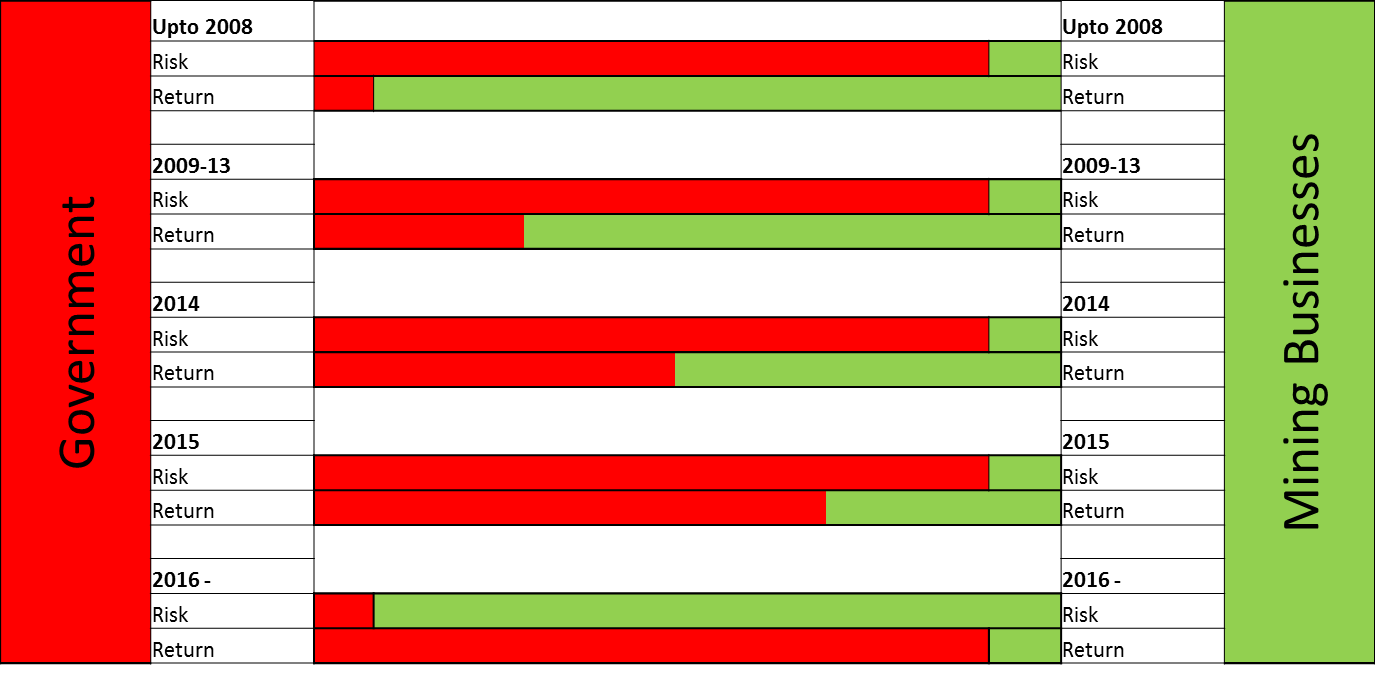
The Risk involved in Mining has shifted towards Mining Business and Return towards Government.
The case was other way around few years back as shown in the figure below:

From the above mentioned, facts it is very clear that the margin for doing Business in Mining has been substantially reduced. It would be an impetus for Indian Mining Industry if the overall taxation is reduced to around 40% (Global Average).It may also be mentioned that after the enactment of the amended act, out of 42 mines only one dozen mines could be allocated through auction. No fresh mine has come to the production as of now.
After amendment of new mining law, the overall tax rate is increased.
Graph showing increase in overall Taxation after enactment of MMDR Amendment Act, 2015

Table Showing Direct and Indirect Taxes paid by Mine owners -Effective Tax Rate (ETR):
All over the world, in India alone approximately 59.8% of total revenue has to be paid to Govt., by way of various tax by the existing mine owners and 64% by the new mine owners. The comparison chart is given below.

In the world Except water, food, and timber all products are from minerals. Unless, the mining operation is not going there is no development for human being. For the reasons best known to them, some people protest the mining activity. On going through the draft mining report prepared by FICCI the following facts are came to light.
High Taxation on Minerals: Pre and Post enactment of MMDR (Amendment) Act 2015
Mine owners have to pay a mix of other Direct and Indirect taxes administered by different authorities. The same has been furnished in the table below:


CHENNAI: When the total value of India’s granite exports over a period of 17 years worked out to a mere Rs 52,000 crore, how can the notional loss suffered by illegal granite mining in Madurai district alone would work out to Rs 1 lakh crore, an association of granite mining companies has asked.
When a PIL relating to illegal mining of granite in Madurai district, for which the first bench of Madras high court had appointed senior IAS officer U Sagayam as legal commissioner, came up for further hearing on Thursday, P Wilson, senior advocate for the Federation of Indian Granite and Stone Industry, said such astronomical figures had been arrived at on the basis of unscientific data.
The first bench headed by Chief Justice Sanjay Kishan Kaul on September 11, 2014 handpicked IAS officer U Sagayam and appointed him as legal commissioner to go into the issues raised in a PIL filed by social activist K R ‘Traffic’ Ramaswamy. After it was clarified that Sagayam would go into violations and illegal mining in Madurai district alone, he filed his first report on November 24, 2015. Granite mining in the district came to a halt because of the case.
Now, the 1,200-member federation, registered in Karnataka, has come to court saying only between 10% and 15% of the total quarried granite would be sale-worthy. Though this is the national and international standard, the legal commissioner had proceeded on the premise that about 80% of the granite was sale-worthy, Wilson said.
Noting that for 17 years from 1996 to 2013, India had exported granite to 150 countries and the total value of the transactions was Rs 52.372 crore, Wilson said internal domestic consumption was very negligible. While so, the legal commissioner had quoted astronomical figures of loss because the calculations was on the basis of 80%-85% sale-worthiness.
Seeking to implead itself, besides the government of India entities such as Geological Survey of India, Indian Bureau of Mines, National Institute of Rock Mechanics, Wilson said only then the exact alleged loss could be ascertained. The court should not proceed merely on the basis of the legal commissioner’s reports, he said.
Advocate general of Tamil Nadu said the state government had not yet taken any decision in this regard and added that it had written to the Centre to find out as to what exactly was the value and loss. On receiving the inputs, a final report would be filed in the court, he said.
The bench comprising Chief Justice Kaul and Justice R Mahadevan posted the matter to January 11, 2017 for further hearing.