Reply given by one Australian Customer about the false news published by a selected paid news reporters

Collusion Of Officials With Beach Sand Miners Revealed In Internal Report


The spin on this internal Indian Bureau of Mines (IBM) report is interesting. Nowhere does the internal IBM report suggest collusion by any of its employees. This allegation is made in this report by ’EAS Sharma, retired bureaucrat who is a keen environmentalist’ (last page para 6). There is no other explanation as to who Mr. Sharma is nor to his expertise in these matters and his comments come with no context. Hence his opinion proves nothing and is an unfounded allegation only.

Therefore the headline of this report is misleading and incorrect.

On the 2nd March 2015 in response to unstarred question N0, 1086 in the Indian Lok Sabha the then Minister of State for Steel and Mines answered a question specifically related to illegal mining, its definition and the application of the relevant Act and regulation across India by the Indian Bureau of Mines (IBM) and which explained the procedures adhered to by the IBM for monitoring of mining across India. It specifically states:

‘At the start of mining activity a tentative scheme of mining is conceptualized based upon preliminary information on geology and reserves. Laying the limits for annual production for the entire life span of a mine, which is generally 20 – 30 years, at the time of approval of mining plan, is not practicable for the following reasons:’ Three reasons are then provided.

As per the IBM internal report it was normal up until the Shah report was released in August 2015, for retrospective approvals to be granted and hence not illegal. Finally one further important point made in this parliamentary report:

IBM has been allowing deviation up to 20% of the tentative annual production indicated in the approved mining plan/scheme of mining’.

These statements go to the very heart of this second report by Sandhya Ravishankar (SR) for they do provide an explanation for the actions by the IBM employees which were applied across all India and largely negate the thrust and allegations of this second report. Hence my detailed responses to S. Ravishankar’s second report are as follows:


Section headed ‘What does IBM have to do with Beach Sand Mining’.

  • Page 2 para 4: There are two errors in this paragraph. Firstly a margin of 20% was automatically allowed but of more relevance is that the Mines and Minerals (Development and Regulations) Act 1957, does NOT stipulate a quantity of mineral to be mined. Each mining lease makes a provisional estimate and then this is adjusted once mined tonnages are known and the reasoning for this is given in the Minister’s reply in the Indian Parliament and referred to above – Lok Sabha, Unstarred question No. 1086, 2nd March 2015.


  • Page 2 paras 6 & 7: These two paragraphs unwittingly encapsulate the confusion that became apparent in the mining approvals process between January 2007 and July 2016. IBM could approve the mining plans for garnet and sillimanite alone until July 2016 and up until January 2007 the Department of Atomic Energy (DAE) was responsible for rutile, zircon, ilmenite, leucoxene and monazite. However in January 2007 when the DAE delisted rutile, zircon, ilmenite and leucoxene from the Atomic Minerals prescribed substances list, they claim that from that date they had no responsibility for the issuing of approvals for the mining of these minerals and hence the responsibility rested with the IBM. However the required corresponding change to the Mineral Concession Development Rules 1988 (MCDR) also delisting the four minerals WAS NOT MADE (Reply affidavit to Amicus Curiae report filed by the second respondent (Dept. of Atomic Energy), dated 25th September 2017) so IBM also stated that without this change in the MCDR they were also not responsible for the mining approvals for these four minerals. Hence both the IBM and the DAE said that they had no responsibility for these minerals from January 2007. Hence possibly incompetence and a fight between these two Government departments may well be the reasons behind the poor application of the two Acts/Regulations. Certainly the industry was confused and anecdotally relate stories of paperwork being held in limbo as the two departments denied responsibility.


  • Page 2 para 8: SR fails to advise that the Mineral Concession Development Rules she comments upon from February this year have been the subject of a stay order in the Andra Pradesh High Court and hence at this time private participants are still allowed to mine mineral sands (excepting monazite). This important point should not be overlooked (High Court of Andhra Pradesh, 15th March 2019, Justices Kumar and Murthy, Writ Petition no. 3335, 2019). This should not have been left out as the reasoning behind the stay order was a lack of fairness which may make the ruling unconstitutional and which is an important judgement related to this report.


Section headed ‘What triggered the Inquiry’.

  • Page 2 paras 9: SR makes the statement that ‘The trigger for the inquiry was the role played by their own officials in helping the illegal mining and transportation of beach sand minerals…’ and attributes this finding to the Amicus Curiae (AC). Once again the statement needs to be made that the findings of the AC are still being tested in court and are NOT FACT and have been rejected by the IBM in their report. The same findings by the AC against employees of the Department of Atomic Energy (DAE) were also strongly refuted in the DAE’s reply affidavit to the AC’s submission and dated the 25th September 2017. The DAE state (Page 4 point 4):


‘At the outset, it is submitted that all allegations made against the second respondent (DAE) as contained in the status report are denied as false and vague and deserves to be dismissed in limine’.


  • Page 2 para 10: As per my previous statement there is no fixed production quantity under the MMDR Act and allowances were made by the IBM across all mining for the reasons given in the answer provided in the Lok Sabha on the 2nd March 2015.


  • Page 2 para 11: The IBM in their internal report stated that ‘The approval of Mining Plan without site inspection was mainly because the mines were not operational ‘(page 77 point 7).


  • Page 3 para 1: The issue of 50% recoveries (which the AC deems impossible) is frankly wrong and again is addressed by the Dept. of Atomic Energy in their response to the AC, dated the 25th September 2017. On page 10 Point 12, second para the DAE states:

‘In view of the above, higher grades in the mining areas compared to AMD exploration reports are possible in some cases. Hence the allegations of influencing officials of AMD are not borne out of facts’.

Secondly in the most recent addition of the IBM Indian Minerals Yearbook 2018, 57th Edition, Ilmenite and Rutile, page 15-5, 5th paragraph makes the following statement:

‘In dry mining, beach washings laden with 40 – 70% Heavy Minerals (HM) are collected through front-end loaders and bulldozers for further concentration….’

Further during the drilling and exploration work we undertook between 2001 – 2004, it was not uncommon for grades of mineral to be well in excess of 50% and in several cases we found areas where the heavy mineral content (beach sands) were in excess of 90%. These three points once again show the AC’s lack of knowledge of the industry and again this illustrates why it is not reasonable nor fair of SR to make statements based upon the untested allegations made by the AC.

  • Page 3 paras 2-4: Certainly the IBM admits in its report that there were lapses on the part of several officers to work within the full range of their powers but, as noted by SR (page 1 para 6), the report states clearly that the lapses were not intentional and ‘are due to the practices in vogue at that time’ (IBM report point 7, page 77). However these practices were applied by the IBM across ALL mining in India (Lok Sabha answer dated 2nd March 2015) and not just mineral sands and hence do not support any claims of ‘collusion’ as alleged in this report.


  • Page 3 paras 5 – 7: Clearly there is confusion here between the royalty paid (3% of sale price as ad valorem basis – Bedi report page 561) and sale price. SR here states two different values being the


‘sale price of garnet was Rs 377 per MT for Tamil Nadu’ (para 5) but then states ‘while a mere Rs 377 per MT was being collected as royalty’ (para 8). Hence this is yet another incorrect statement.


Further, claims that this was ‘causing years of loss to the state exchequer’ is clearly not economically sound as no sane business would sell garnet domestically at Rs 377/tonne when they were achieving between ‘Rs 15,000 to 18,000’ as the actual export price. Hence any argument that the exchequer would be losing revenue is not rational for all miners would have been exporting at the higher price and paying the 3% royalty rate which was beneficial to the exchequer.


Section headed ‘Who are these officials & what did they do’.

Regarding the 14 cases examined the opening statement by SR given below is completely unsubstantiated. She states:

‘Let us look at some of the cases where officials turned the other way or even actively colluded with private miners to allow illegal mining of beach sand minerals to continue’.

This statement is designed to lead into the case studies and yet no proof of collusion is provided beyond this opinion. To state at the top of each box ‘Illegality’ describing activities that were approved by the IBM and then proceed to make an assumption that these approved activities were illegal and indicate collusion between the IBM employees and the mining companies, are not supported by fact. Clearly the matter is far more complex than these statements indicate and once again show that there is a narrative being followed in this article rather than an investigation supported by facts. Hence SR’s strident claims of illegality and collusion do not hold up to scrutiny.

As explained previously there are no limits provided for in the MMDR Act nor in the MCDR which restricts production and as advised in both the internal IBM report AND the response to a question in the Lok Sabha, the retrospective granting of licences and production was standard procedure for the IBM across India.

In response to the final paragraphs of this second report (pages 9 & 10) the following comments can be made:

  • Page 9 paras 1 – 7: The IBM report does explain in some detail the reason for the lapses it found in the application of the rules associated with mining in the 64 leases examined. However as explained before this is a complex matter made worse by the lack of clarity as to which department was actually responsible for oversight from January 2007. However at no time does the IBM report ever draw the conclusion that there was collusion between the mining companies and the employees of the IBM. Further (para 7,) as far as I can determine, the issue of allowing for replenishable reserves in mining areas not on the beach only occurred in one instance and it was a lease held by Indian Garnet Sand Company who was found to be illegally mining without the correct licences in 2007. At no time did the IBM report state that ‘The one lapse admitted to by the IBM is that of hiking the replenishment reserves in mining plans in a bid to help the miners mine more’.


  • Page 10 para 6: It is in this paragraph that the opinion of EAS Sharma is given but as previously stated, his opinion, presented without context, authentication or proof of any collusion from reputable sources, is irrelevant.


  • Page 10 para 10: S. Ravishankar’s final point regarding the time of reckoning is a critical point for not only will the various Government departments noted face this reckoning but so will the Amicus, the Bedi report and the Sahoo report be subject to the same scrutiny.


In summary:

  • There are several factual errors in this second report and once again a lack of knowledge of the industry is shown.


  • Once again the article relies upon one report and does not take into responses from other participants in the matter such as the DAE and their response to the AC’s report to the High Court or the actions of the Andhra Pradesh High Court.


  • Important facts relevant to the matter such as the method of operation common to the IBM and its employees are left out.


  • Erroneous statements and headings are used which attribute findings of collusion to the IBM report when no such finding was made by the said report.


  • The use of third party opinions stating collusion with no context, explanation or proof is misleading.


  • Inflammatory statements are made with no proof or substance behind the allegations.


  • Continued reliance upon reports from the AC which have not been tested in court again expose this report to the criticism previously expressed that this second report is one sided and lacks accuracy.

False news spread in International Media by vested interest reporters – Detailed reply with statutory documents to establish BSM Industries are running in accordance with law.

As a part of Sandhya’s false propaganda against Indian Beach Mineral Industry, one reporter from France by Name Cecile Schilis-Gallego asked some information about beach mineral Industry.

My name is Cécile Schilis-Gallego, I’m a journalist with Forbidden Stories. Forbidden Stories is an international consortium of journalists that collaborates with major news outlets including, among others, The Guardian, France Télévisions, WDR, Le Monde, Radio France, Süddeutsche Zeitung and Die Zeit. We pursue investigations of journalists who have been threatened, jailed or killed”.

The above said words will establish that, she was misguided by Sandhya Ravishankar about beach mineral industry. Fortunately she also confirmed that,  the reply will be given due wait-age in the article. Accordingly, VV Mineral Manager Mr.Sakthi Ganapathi send detailed mail with strong evidences for the questions. Hope they will publish the same as it is in their article. Let us wait and see whether their acting fair and consciously or they are also under the control of Sandhya Ravishankar.

Copy of mail and the annexurs supporting the reply send the reporter Cecile is given below for our members as well as general public information.

Mail to Forbidden

Anx-2Anx 3

Anx -4Anx-5

Anx-6

Anx-7

Anx -8

Anx-9


Anx-11


Concrete reply for false allegations about beach mineral industry

Everyone knows that, some vested interest people are working against this beach mineral industry.  Some of the media reporters were misguided by vested interest media people like Sandhya Ravishankar. Accordingly one Mr.Ashish Malhotra from The Guardian approached our member VV Mineral for an interview.  Fortunately Mr. Jonathan Watts, Global Environment Editor, The Guardian as well as Ashish Malhotra confirmed that VV Mineral side also will be published equally.  Hence detailed reply send to them refuting all the false allegation along with documentary evidences. The following points are explained in detail with evidence from statutory authorities.

          1) There is no Coastal Erosion due to the beach mineral mining. Particularly there is no erosion in the private companies mining lease areas. Moreover sea erosion is a world wide problem. The main reason is Global warming. Even in India, more than 40% of the beaches are affected for various reasons.


         2) The mining lease area and processing plants minimum 500 meter away from habitation. No employees or the owners who are residing adjacent processing plants are not affected either chronic Kidney disease or by cancer or by any other disease. The Kidney disease is common all over the world. In Japan for one million people 20 dialysis centre are available. Whereas in India it is only five. All over India average 17% of the population affected by Chronic Kidney disease (reasons are given in detail). Worldwide out of one lakh people 78 people are affected by cancer. In Tamilnadu Chennai, Kancheepuram, Thiruvallur, Cuddalore, Coimbatore alone the first four places cancer affected districts, where there is no beach mineral mining.


           3) No land is acquired by any private mining company. Only government companies alone initiate land acquisition at rock bottom price.


         4) The stoppage of mining operation did not prevent export of mineral which has already suffered royalty. Only royalty suffered mineral alone exported during the mining stoppage period. Export does not comes under the purview of MMDR Act – confirmed by Govt., of India, Ministry of Mines.


          5) No personal attack or threat to any type of public or media people. Even against the paid news reporters Sandhya herself also only legal action is initiated through court of law. Various cases are pending in various courts. The case filed by Sandhya Ravi Shankar against VV Mineral was dismissed by the court.


Copy of mail send to The Guardian along with attachments are given below for the general public as well as our members information. Let as wait to see whether both sides will be published or  as usual some other new stories created by Sandhya is published.

*******************


From: S Vaikundarajan <vaikundarajan@vvgroup.biz>
Date: Sat, Jun 15, 2019 at 11:19 AM
Subject: Re: Interview request
To: Ashish Malhotra <ashish.z.malhotra@gmail.com>
Cc: Jonathan Watts <llamalad@gmail.com>, Jon Watts <jon.watts@theguardian.com>


Dear Mr. Ashish Malhotra,

Its funny to see how reputed magazines such as yours are easily deceived by someone like Mrs.Sandhya Ravishankar.  Your question pattern clearly reveals that you are being misguided and are working closely with our competitor Mr.Daya Devadas who has a nexus with Mrs.Sandhya Ravishankar and Mr.Kumaresan, who thrives purely by threatening people for money.  I also understand you are seen along with the competitors, Sons of my brother Mr.Kumaresan (Mr.Sudharson /Mr.Sundaresan) and few of their henchmen in Tuticorin.  So, I have little faith in the fairness of your story. 

For your kind information, the only one mining company that has been proven to do illegal mining is someone named Daya Devadas, from Indian Garnet sand company and Southern Enterprises whose operation was shut in 2011, for which he is retaliating against other mineral producers in this industry.  Persons like Sandhya Ravishankar are only aiding this process.  So, please do your homework on the persons who are helping your so-called investigative story.  Sandhya who claims herself a hero and revolutionary against mining industry, has not written a single word about Daya Devadas or this illegal mining activity.  That should tell you something. You can find out government order determine the mining leases of our competitor for illegal mining in https://www.beachminerals.org/large-scale-illegal-mining-major-violations-tamilnadu-govt-determine-mining-lease-granted-southern-enterprises-belongs-dayadevadas-claim-president-federation-o/  and in https://www.beachminerals.org/39-lakhs-m-ton-illegal-minor-southern-enterprises-special-leave-petition-dismissed-honourable-supreme-court-02-02-2015-vide-slp-cc-nos-740-7412015/

Nevertheless I strongly believe reputed magazine like Guardian will make sure the story goes unbiased with versions of all people and their views.   You have also confirmed the same in your previous email and so here are my replies :


Your Question:

1)  Villagers say the mine has caused coastal erosion? Do you accept this and what have you done to prevent this and compensate those affected. 

Our reply :  All over the world coastal erosion is a serious problem. The main reason is Global Warming etc., The coastal mining leases are granted in southern districts like Tirunelveli, Tuticorin Districts in selective pockets to private parties with proper CRZ Clearance, where there is no sea erosion or damage to the shore.  But even in non-mining lease area, sea erosion is a serious problem. For example Rameswaram and Nagapattinam Districts and Ennore near Chennai. Due to business motive, our competitor company owns to Dhaya devadas who have political influence in the previous Central Govt., engaged some Retd. officials to spread rumours against this industry. None of our mine lease area is affected by sea erosion.

For your information, India has more than 7500 Kms length of coastline, whereas 1350 kms coastline has been reported to be affected by sea erosion. This has been confirmed by Govt., of India, Coastal Erosion directorate. (copy attached).

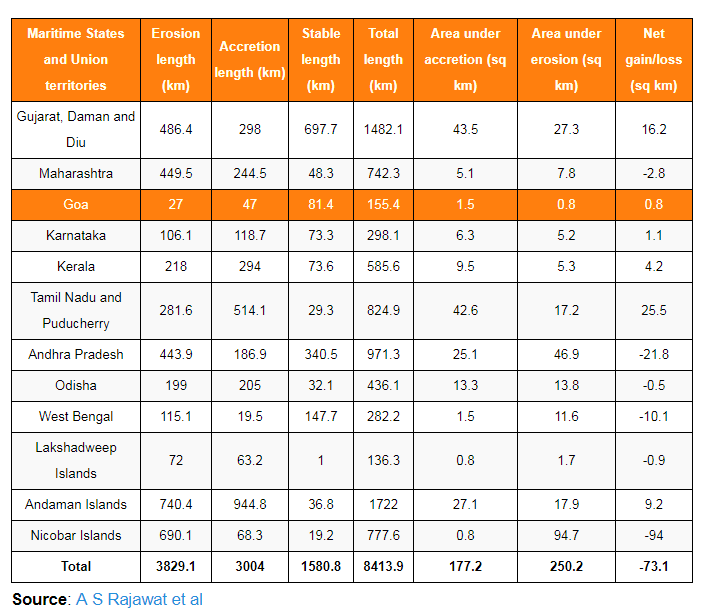
“As much as 45% of India’s 8,414-km long coastline is facing erosion, according to a new study based on satellite data over 15 years, published in the Indian Academy of Science’s journal Current Science.

The study–the most detailed thus far–also reports that close to 19% of the coastline is stable and about 36% is showing accretion, or expansion. The Indian coast has lost a net area of about 73 sq km.

Scientists from Space Application Centre (SAC), Ahmedabad and Central Water Commission, Ministry of Water Resources, compared satellite images from two time periods–1989-91 and 2004-06–to measure the changes to India’s coastline.

Source : https://www.business-standard.com/article/current-affairs/45-of-india-s-coastline-facing-erosion-115081200513_1.html

If you go through the above picture you can find out that, in Tamilnadu area under accretion is 42.6 km and area under erosion 17.2 km alone. Moreover all the states, were no beach mineral mining also severely affected by sea erosion.  The renowned scientist Stephen Hakkins recorded that by 2600, our Globe will become fire ball. This is because of increase of population and abnormal usage of powers etc.,

Source :  https://www.cnbc.com/2017/11/07/stephen-hawking-humans-will-turn-earth-into-a-giant-ball-of-fire-by-2600.html

One fisherman village Panchayat President herself has reported that there is no adverse effect consequent on beach sand mining. According to her voice, there is well planned false propaganda only with malicious intention.  The concerned video and audio recording are already in possession of the Ministry of Environment and Forests of Govt. of India.  We are also in possession of the same and that we have put out the wordings in our website.   You are invited to visit this site  https://www.beachminerals.org/fisherman-community-people-supporting-beach-mineral-mining-manavalakurichi-town-panchayat-president-confirm/  to find out the veracity of this reply.

“ A scientific study by the coastal erosion control directorate (CECD) nullifies the common         allegation that beach mineral sand mining is the major reason for sea erosion in southern          Tamil Nadu.

Disclosing this to DC, Dr A.G. Murugesan, scientist at Sri Paramakalyani Cen­ter of Environmental Sc­ie­nces, Manonmaniam Sun­da­ranar University, quoting the CECD report of the Union ministry of earth sciences, said waves and high tidal attacks, monsoonal vagaries, unpl­an­n­ed coastal protection projects like the breakwaters and fishing harbours were mentioned as the major reasons for sea erosion in the coastal regions of India.

The study ruled out beach sand mining, for industrial purpose, as a major threat to the shoreline, as beach mineral mining leases have been granted only for about 40 km in Tamil Nadu, Kerala, Andra Pradesh and Odisha.

The study, done in the entire 7,516-km-long coastline extending from Gujarat in the west coast to West Bengal in the east coast, has identified 1,350 km that are vulnerable to sea erosion.
Prof Murugesan said the CECD study has disclosed the truth that the mined areas in the coastline have been replenished due to constant tidal action.

Quoting the study, he pointed out that “Beach mineral mining has no connection with seawater intrusion that is primarily caused by overexploitation of groundwater.”

Concurring with Prof Murugesan, an official source at the Tamil Nadu water supply and drainage board said Thoothukudi city, around which no beach sand mining activity has been carried out for about 30 km on either side (north and south) of its coastline, has salty groundwater for about 10 km from the coast.

Referring to the case of Uvari in Tirunelveli district, where sea erosion was very severe, it has been said the region is located in the high erosion stretches, where erosion was not a recent phenomenon. Sea erosion was said to have been severe in Uvari even before mining leases were granted.

According to local fisherman Michael Adiyan, the original Kappal Matha church at Uvari was completely eroded in the early ‘50s, even before the advent of the beach sand mineral companies in the area.

Source : http://www.deccanchronicle.com/131211/news-current-affairs/article/mining-does-not-lead-sea-erosion%E2%80%88study

This being the fact, it is quite silly to point our heavy mineral mining which is done probably in total of 15 kms (out of 8500 KMs of Indian coastline), in some coats of TN, AP and Kerala is the reason for it.  In fact even in this 15 kms stretch, most of the mining is done atleast 500 metres away from shoreline in some case extending to 4 kms away from shoreline.  How can this be a reason? 

Also since 2013, no heavy mineral mining is happening in TN, has it stopped sea erosion?  Well learned journalist such as you can easily apply your mind on such silly accusations.  Out of total  85 mining leases in entire India, hardly 3-4 mining leases can access close to shoreline.  So, its quite obvious this is a false propaganda done by our competitors.  For your information non of our mining lease area is affected by sea erosion. In fact, our company is helping in reducing Global warming. Please visit : http://www.icontrolpollution.com/articles/role-of-vvmineral-in-reducing-global-warming-throughgreen-mining-technology-of-garnet.pdf

Your question :

2)  Villagers allege that the beach mining has led to an uptick in health problems in the nearby region, including kidney disease and cancer? They feel that water in the area has been contaminated by your activities, and that the dust they have inhaled from the mining has also affected their health. How do you respond?

Our reply :

Our own houses are close to the beach mineral factory. In our mines and factory, more than 4600 employees were working. None of the employee affected either by Kidney disease or cancer. This has been proven by the yearly medical check up taken among the employees.  Moreover our mining area and processing plants are minimum 500 meters away from the habitation. According to the Director General of Mines Safety norms, 200 meter distance enough. Whereas, we have kept 500 meters distance from the habitation. Then how it is possible?

All the mining companies in TN and AP employ dry mining methods, which can’t mine below water table.  The dry mining is simple excavation mining where there is no drilling, blasting, bore holing, tunnelling, chemical process, etc. none of which is used.  This being the case, where is the process of water contamination?  In fact, since all the private companies have stopped mining in TN since 2013 and mining in AP has been stopped since 2018, the only ones operating are the Indian Government company named IREL who is operating their mine in TN, Kerala and Orissa.  Perhaps it would be an eye opener of you to visit their mining areas and interview the locals around their operation.  In fact people are celebrating their operation for the employment they provide. 

Unless you crush any mineral or drill for any mineral, there is no question of dust as well.  For your information,  out of all the 7-8 beach sand producers in India only we have valid environmental clearance and valid pollution Control board consent under Air Act and Water Act. Even Central Govt., company also does not have the same clearances. Since your partner Sandhya Ravishankar’s target is Vaikundarajan and V.V.Mineral, you are not speaking about the government company which is running without valid clearance. Perhaps you should dig more on the clearances obtained by IREL (Central Government company) and bring the truth to the open forum.  Such a pity, Sandhya’s target is not them, but us. 

Cancer and Kidney diseases are common all over the world and are not limited to any specific areas. In fact, especially near Kerala, where IREL’s operation exists, naturally occurring beach sands contain the radioactive mineral named monazite in high percentage. Even there, Epidemiological studies on the cancer incidence rate carried out in these areas indicate no cases of health problems, cancer or kidney failure in these areas which can be attributed to the background radiation levels. In fact Government has regulations to maintain the back ground radiation levels in all the coastline areas.  This is the study report by Government of India available in https://aerb.gov.in/images/PDF/f1.pdf  (Page 54)

Given below are a few devastating statistics about chronic kidney failure in India.

  1. 17%of Indians have some form of chronic kidney disease. This figure was reached that in a study conducted by Harvard Medical School in partnership with 13 medical centres  all over India. One third of the above people have advanced stages of the disease.
  2. There are 60 million people with diabetes in India, more than any other nation on the planet. Sadly, the majority of them are either  not diagnosed or poorly treated.
  3. At least30% of diabetics will develop chronic kidney disease because of diabetes.
  4. People with the last stage of kidney failure (technically called Chronic Kidney Disease Stage 5 or CKD-5) require dialysis and/or kidney transplantation as a life sustaining treatment. 40 % of such patients would have developed kidney failure because of diabetes.
  5. 2,00,000 new patients need dialysis treatment every year in India.  but the unfortunate reality is that only 10 to 20% of them get proper treatment.  The remaining are either not diagnosed or unable to continue proper treatment.
  6. Statistics suggest that there should be almost 20,00,000people on dialysis in India a sof today. The reality is that there are only about 1,00,000. The rest have been lost due to non-diagnosis and non-treatment.
  7. The majority of chronic kidney failure patients are diagnosed in the last stage. Though proper statistics are not available, it is accepted that almost 50%first see a nephrologist (kidney specialist) only in the last stage.
  8. There are0.4 dialysis centers per million population in India. By contrast, Japan has 20 dialysis  centres  per million  population.
  9. Only4,000 kidney transplants are  performed every year in India. The United States  with one fourth the population of India performs 16,000 such operations per year.
  10. Kidney failure can affect people of any age group. While in the west, the majority of patients are elderly, in India kidney failure patients are much younger and affects predominantly the working population.
  11. High salt consumption (dry fish) or any foods with high salt consumption can also be a pointed as a contributor to Kidney problems

Source : https://www.practo.com/healthfeed/some-devastating-statistics-about-chronic-kidney-failure-in-india-10945/post

Cancer in Tamilnadu

Tamil Nadu State Cancer Prevention and Control policy is being developed with specific focus on prevention, early detection, screening, treatment including high end facilities, follow up and palliative care. Proposed for implementation over ten years period, it is envisaged that Tamil Nadu will have a functional system of cancer control with a network of equitably accessible ‘State of Art’ cancer treatment facilities which would reduce the cancer incidence, morbidity and mortality rates in relation to other States by 2030. Around 55,000 new cancer cases are identified every year in Tamil Nadu. It is higher among women (84 per one lakh) than men (65 per one lakh) in the age group of (35–64) years amounting to 1 in 13 people running a life time risk of developing cancer. As per Cancer Registry, high incidence of cancers is observed in Chennai, Kancheepuram, Thiruvallur, Cuddalore, Coimbatore and Kanyakumari districts.”

Source : http://cms.tn.gov.in/sites/default/files/documents/hfw_e_pn_2017_18_0.pdf  (Page 231 and 232)

The said Tamilnadu Government report is available in government portal. You can find out that, districts like Tirunelveli, Tuticorin were private beach mineral mining leases are granted are not in the first three places. All over the India out of one lakh, average 78 people are affected by Cancer. You can find out the same from the reply to parliament question no. 647.  The following picture will establish the various reasons for cancer.

Source : https://www.thebetterindia.com/74188/cancer-awareness-india/

So please get your facts right before you are being deceived or misguided by someone like Sandhya Ravishankar or Mr.Kumaresan or Mr.Daya Devadas.

So, stopping the mining in 2013 in TN must be a boon for the coastal regions since they are relieved from the kidney and cancer problems?  According to Sandhya atleast this must be true. 

Your Question:

3) Villagers allege that land for the mining was acquired illegally/without their consent? How do you respond?

Our Reply

More than 90% of the mining leases are in our own land. We are not approaching for land acquisition either government or through other sources. Only Govt., companies alone acquire land for mining. Whereas in our cases, we purchase the land who are ready to sell their land and based on the sale document we purchase the land and transfer the name and get the mining lease.  Though this method is slow and inefficient, we win over the support of the land owners who gets paid in market price.  But this method has its own de-merits as well.  Ill minded fraudsters will threaten the company to acquire their land at an exaggerated price (atleast 20 times the market price) or else they will spread negative publicity against the companies.  We have faced such personalities too, who is still threatening us to buy their land a high price.  Unfortunately they also have friends like Sandhya Ravishankar who can help them extort money from beach mineral producers. 

Someone by the name Mr.Saravanakumar who tried to get money from us on this method and he give a complaint and file a case and give media exposure for that to get money. His attempt was failed and my legal battle finally give victory after 7 years. When our Manager came to Tuticorin along with my brother Kumaresan’s son, this gentlemen also seen with you. So, this question specifically wants to favour him.  Please remember he has already filed complaint in the police land grabbing cell and approach judicial magistrate and District Judge and finally approach the High Court. All courts dismissed his claim.  So, he is trying his best to do a smear campaign on us.  Other than that, we have always won support of public. 

Your question :

4)  An expert report filed in court says you continued the international export of minerals after a ban on mining and new transport permits was issued in 2013. How do you respond?

Our reply :   Please note that is not expert report. The Tamilnadu Government stopped the mining operation and stoppage of transport permit during 2013 without any jurisdiction and without following the statutory requirement for political reasons to fix up us.  Without any alternate remedy, I approached the Honourable High Court and the Honourable High Court set-aside the order of the State Government.  Now the State Govt., filed appeal and the appeal is still pending.  The Tamilnadu Government stopped the mining operation alone. There is no ban for export of existing royalty paid minerals, as, already the Honourable Supreme Court in Cavery Chetty case clearly decided that, once royalty is paid, the State has no control over the mineral. Moreover export of mineral does not comes under the purview of Mines Act. Government of India Ministry of Mines itself clarified the same vide its letter No.16/01/2016-M-VI dated 10.10.2016 (copy attached). Once in every three months after 2013, the State Govt., itself get the export figure from the Port to verify whether these all are royalty paid minerals or not. We have paid royalty for 98 lakhs M.Tons from 2001 to 2013. After export until 2016, we have approximately 36 lakhs M.Ton of royalty paid minerals in various stages. The High Court appointed Sahoo Committee also confirmed the correctness of our stock.

If you inform the name of the expert and the nature of the report, I can able to furnish full and correct reply with documentary evidence to establish that, the report you have mentioned is not correct.

Your question :

5) Villagers say they have faced attack, threat and intimidation as a result of speaking out against mining. The journalist Sandhya Ravishankar also says she has faced threats and intimidation because of her reporting. How do you respond? Specifically, she says CCTV footage of her meeting with a source was leaked. Was your company involved in this leak?

Our reply :  Please be informed Sandhya Ravishankar has personal enemity against our company.  Our business group also owns a reputed local TV News Media since 2014.  During its initial phase, Mr.Prem shankar (none other than Ms.Sandhya ravishankar’s husband) approached us to manage the media operation.  But we denied the opportunity.  There started the enmity.  She started her partnership with Daya Devadas only after that. 

Please note no village people is against the mining operation. Only the vested interest people who are working under Sandhya Gang alone speaking against mining.  For your information, you can find out the video in www.beachminerals.org/videos  Where in the video, you can find out even an Retd. IAS officer are working under the instruction of our competitors and they gave interview against us as per the advice of our competitor. Also a person Anton from one Fisherman village to whom our competitor is educating how to show emotions to spread false message against us, when talking to media can also be seen.  It is similar set of people who are misguiding you. 

Like I told you before, Sandhya represents our competitor Daya devadas who was found doing illegal mining and their operation was shut in 2011.  He couldn’t bear the thought of other producers continuing to capture the market share, he took it upon himself and determined to bring down the entire industry.  Slowly he launched smear campaign against us in 2013, instigated the then Government to bring mining ban.  Since then he has been continuing the attack this industry and all the producers with baseless and false accusations.  Sandhya is one of his close aid.  We initially thought she was fair and unbiased, met her few times, provided with all the counter facts on accusations made by our competitors.  But she chose to ignore it and carry only the competitors false versions.  So, we have in fact filed two defamation suit against her.  This has only made her furious to continue with her personal attack on us.

We strictly believe in taking only legal action through court of law.  Already two criminal cases pending against her in Judicial Magistrate court and one case is pending in the High Court, and she herself filed a case against me in the City Civil Court, Chennai when we filed detailed counter to scrap the plaint, the Honourable City civil court, Chennai accept our plea and scrap her plaint and dismissed the case filed by her in O.S.No. 1649 of 2017. 

We are a reputed organisation and always taken a legal recourse for any of the issues we face.  Threatening the journalist is the last thing we will do.  Can she provide one evidence to prove this?   She can’t. 

I pity her situation because she has been jumping media organisations for every 3-4 months and she tries to use that media to support Mr.Daya devadas by writing false information about other producers.  We explain the facts to the media group or editors and they warn Sandhya.  She jumps to the next one and tries the same.  This is a cycle. 

Suddenly one day she started accusing us of threatening (without any proof of course) and we wanted to learn why.  On asking around, we found that, she doesn’t have a good reputation in the press club for she was taking sides in their election process and many senior journalist didn’t like that.   When entire TN was supporting Jallikattu festival, she was openly commenting against it when staunch TN social media users troller her.  She conveniently played the victim card accusing that against us.  Jallikattu or her press club issue has nothing for us and we have no affair to intervene or comment her role.  Some random comments made in social media by random guy has to do with us?  She hasn’t done any legal stories to support her, so she has to thrive by playing victim card against beach mineral industry. 

Even the videos of her meeting the so-called source was widely spread in social media (even a reputed whistle blower Savukku published it in his timeline).  He claimed Sandya was visiting Ex-DGP to misguide DMK using his closeness to DMK.  So that also was blamed on us.  In fact someone in social media picked up the video from social media and sent to us saying Sandhya was meeting to conspire against us.  We can only ignore such things. 

Please apply some logic my friend and provide us a concrete proof so that we have something to answer to. 

But I must tell you, it is a big nexus in which Sandya is involved in and they have the habit of publishing a story every time a court hearing for this beach mineral case comes to court.  Their intention is only to cause pre-judice against us in the minds of the judges, so that justice can be delayed. 

One of my employee who manage one personal blog http://vetri3337.blogspot.in/.    You can find lot of information about Sandhya Ravishankar.  Also please ask your so-called sources, friends of Sandya or even Sandya why they conveniently forgot to talk to Daya devadas or their illegal mining in 2011.  I am sure she never disclosed the fact that her husband was denied an opportunity in our group.  With personal enmity and history in the past, do you think she will give a fair opinion on us?  You are being used to fulfil her vengeance.  Please take a clear call.

I hope your story will be based on the above said five points. As promised, please publish my side reply also.  I still count you will do fairness to your journalism which is the fourth pillar of democracy.  Any deviation from my reply or misrepresentation will only push us to take legal recourse. 

Coastal erosion dierctorate lr

Export of Mineral does not comes under MMDR Act – MOM RTI lr – 10.10.16

With kind regards

S. Vaikundarajan 

———–

On Thu, Jun 13, 2019 at 11:35 PM Ashish Malhotra <ashish.z.malhotra@gmail.com> wrote:

Hi Mr Vaikundarajan,

Thanks for your email. I do not know Mr Kumaresaran’s sons or employees, and we would have conducted the interview on that day had we heard from you directly.

In any case, we are glad to hear you’re interested in the interview. However, as we have told you before, our deadlines are quite tight, which is why we have been trying to schedule this interview with you for more than one week. We have really tried our best throughout this time to meet you and get answers from you. But now our deadline is fast approaching. It is in fact, this coming Monday morning. I tried to call you quite a few times this afternoon/evening to try and ask you the questions in the most timely manner possible, but I was not able to get through. I am sending you them now here in an email, but as I said, please keep in mind that we need answers as soon as possible because our deadline is Monday morning. We cannot wait until the dates you have suggested, and hope to get an email response from you with the answers before Monday.

Below are some questions for my article for The Guardian. But as I have mentioned before, we are working in collaboration with many other journalists, and I do believe that some of them have reached out to you with separate questions. Please keep in mind that we would possibly use some of your answers to those in our story for The Guardian as well.

1) Villagers say the mine has caused coastal erosion? Do you accept this and what have you done to prevent this and compensate those affected. 

2) Villagers allege that the beach mining has led to an uptick in health problems in the nearby region, including kidney disease and cancer? They feel that water in the area has been contaminated by your activities, and that the dust they have inhaled from the mining has also affected their health. How do you respond?

3) Villagers allege that land for the mining was acquired illegally/without their consent? How do you respond?

4)  An expert report filed in court says you continued the international export of minerals after a ban on mining and new transport permits was issued in 2013. How do you respond?

5) Villagers say they have faced attack, threat and intimidation as a result of speaking out against mining. The journalist Sandhya Ravishankar also says she has faced threats and intimidation because of her reporting. How do you respond? Specifically, she says CCTV footage of her meeting with a source was leaked. Was your company involved in this leak?

Hope to hear from you soon.

Best,

Ashish

———————-

———- Forwarded message ———
From: Jon Watts <jon.watts@theguardian.com>
Date: Thu, Jun 6, 2019 at 5:08 PM
Subject: Re: Interview request
To: S Vaikundarajan <vaikundarajan@vvgroup.biz>
Cc: Ashish Malhotra <ashish.z.malhotra@gmail.com>

Mr Vaikundarajan,

Thanks for your prompt reply.
Our main mission and duty as journalists is to report stories in a fair and balanced way. As you have discussed with our team on the ground, we want to spend as much time as possible with you to make sure you can answer all questions/criticisms people may ask or make about you and your companies. We can assure you that your positions and views will be reflected in our story and that your quotes will be used accurately and verbatim. We are seeking your input because we know the importance of the minerals you work with to the modern economy and want to have your input as an entrepreneur, not just in response to allegations others may have made about you. We appreciate your concerns and understand that your request comes after a long and complex legal battle including with competitors.
Please let me know directly if there are any other concerns you have. Our team has travelled a long way to meet you today and it would be a shame if there would be no interview after all the email and phone exchanges you have had with them.

Best regards

jon


Jonathan Watts

Global Environment Editor
Jonathan Watts

Global Environment Editor

The Guardian
Office +44-203-3533773
Mobile +44-7384241100

FIMI urges govt to lift beach sand mining ban on private firms

FIMI urges govt to lift beach sand mining ban on private firms

In its latest report “Mining Matters for India”, Federation of Indian Mineral Industries said the ban has put a large number of jobs at stake.

Beach sand mining ban on private players has resulted in loss of exports worth Rs 4,000 crore and Rs 5,000 crore in revenue, mining body FIMI has said, demanding rescinding the order.

In its latest report “Mining Matters for India”, Federation of Indian Mineral Industries (FIMI) said the ban has put a large number of jobs at stake.

“In the case of beach sand minerals (BSM), private sector has been debarred for mining, putting numerous jobs at stake and depriving the country of revenue to the extent of Rs 5,000 crore and exports of about Rs 4,000 crore annually,” FIMI said in its latest report.

At present, only government companies are allowed to engage in beach sand mining after the Ministry of Mines vide a notification in February this year banned the private players.

“The Government should improve the regulatory mechanism and private sector should be continued to be allowed for mining of beach sand minerals and the Ministry of Mines notification…barring private sector should be rescinded,” it said.

The report also highlights FIMI’s demand for considering mining as an ‘Independent Activity’, and not as captive to any downstream metal industry such as steel, aluminium, etc.

“While mining is a business of volumes, captive mining limits the scale of mining, neglects mineral exploration limited to plant requirement, leads to selective mining and wastage of resources,” the report said.

The private sector in future should be the main source of investment in reconnaissance, exploration and mining with right to seamless transition, transferability with security of tenure, it said adding, the government agencies such as GSI, MECL etc may continue to perform the exploration and surveys on regional basis and in areas where private investment is not forthcoming.

“The Government of India should create a level playing field for both private (captive and non-captive) and Government sector companies in terms of tenure of leases, area selection, etc,” it added.

Much of the contribution made by the mining industry to ensure raw material security for India’s sustainable growth has not received the due attention of the stake-holders and society at large, it said.

FIMI also demanded that the contribution of mining should be viewed in light of the multiplier effect it has across the entire economy and not just its monetary contribution to GDP.

The industry body is committed to contribute to the sustained growth of the mineral sector in a sustainable manner for economic growth, raw material security of the country and socio-economic development particularly in remote and tribal areas, it said, and urged the government to initiate steps to ensure its rightful position as a growth engine in the economy and unlock the full potential of the Indian mineral sector.

IMPACT OF THE MINISTRY OF MINES NOTIFICATION GSR 126(E) DT. 19.02.2019 AND  GSR 134(E) DT. 20.02.1019 BY REDUCING THE THRESHOLD VALUE (TLV) OF BEACH SAND MINERALS.

As per the above notifications, the private mining lessees for beach sand minerals will have to relinquish their rightful mining leases. No fresh mining lease could be granted for beach sand minerals, for any private players. The Vision of the National Mineral Policy (NMP), 2019, is while the Government Agencies will continue to perform the tasks assigned to them, for Survey and Exploration, whereas the Private Sector would be encouraged to take up Exploration activities. The aim is to promote Domestic industry, to reduce Import Dependency and to feed into Make in India initiative. Moreover the MoM Notifications GSR 126(E) DT. 19.02.2019 and GSR 134(E) DT. 20.02.1019 are totally deviating, contrary and conflict, to the  Vision of NMP 2019.


National Mineral Policy, 2019, insists that the regulatory environment is conducive, to ease of doing business with simpler, transparent and time-bound procedures, for obtaining clearances. Since mining contributes significantly to state revenues, there is a need for an efficient regulatory mechanism with high penetration of e-governance systems. Mining contributes significantly to employment generation, thus, there shall be a keen focus on gender sensitivity in the mining sector at all levels. But the above notification is completely against the National Mineral Policy, 2019, notified by the MoM, Government of India.


There is a rumor that, the above said notifications are issued in order to take action against, Illegal Mining complaints against Private Mining Lessees. It is pertinent to point out here that, there are several procedures to penalise and punish the illegal miners, in accordance with the law and in case, if the lessee is punished, then automatically the leases will get terminated. Whereas in this case, only based on the complaints, these Notifications were issued. This is absolutely against the National Interest.


Due to business rivalry, the complaints were framed by a section of people, allegation against all other Private Beach Mineral mining lessees. In several occasions, the State and Central Govt. Authorities carried out Inspections, along with Executive Magistrates and submitted Inspection Reports that, the alleged complaints are false and baseless.  Such Inspection Reports are readily available in Ministry of Mines file number 16/90/2007-M.VI (Part-IV) and 16/13/2013-M.VI. The Tamil Nadu State Govt. vide their letter No. 7810/MMD2/2011-1 dated 23.07.2013, also sent the Detailed Report stating that, all the complaints are False and the allegations were made, only with Business Rivalry.

It is pertinent to point out here that, from the year 2013 onwards, the entire mining operations were stopped and the lessees are permitted only to process the existing mined minerals stocks. So, the present Notification is absolutely unwarranted and unjustified.


Our Country have significant Reserves of Ilmenite, Garnet and Monazite containing  Rare Earths (Table 1), but these Resources remain grossly under-utilized with the Production to Reserve Ratio (PRR) being a meager of 0.0018%, when  compared to Global PRR of 0.01%. India is stuck in this paradox and must leverage its plentiful Resources, to transform into a major Global Producer.

S.No. Mineral World Reserves

Million Tonnes**

Reserves in India

Million Tonnes*

Percentage share of Global Reserves
1 Ilmenite 1400 593 35
2 Garnet 420 168 40
3 Sillimanite NA 226 NA
4 Zircon 243 34 14
5 Rutile 310 31 10
6 Monazite 17 12 71

Table 1 – (*Indian figures are based on  AMD, Hyderabad Report. **World figures are based on USGS Report for the year 2013)


Beach Sand Minerals and their Derivatives find Diverse Applications, in day to day use as well as, Strategic and High-tech Applications. With proper Encouragement and Recognition from the Government for the BSM sector, this could be a Mega Opportunity, for a successful “Mine In India” and “Make In India” Programmes.


The BSM Sector was brought under the controlled regime, due to the presence of the mineral Monazite. It is pertinent to note that until 1998, this sector was restricted only to Public Sector Companies and it was observed, there was no Substantial Developments in the country.  Recognizing the untapped Potential of the Beach Sand Minerals sector, the Department of Atomic Energy (DAE) announced the Policy on Exploitation of Beach Sand Minerals in 1998 and opened up this sector to wholly Indian Owned Private Companies. This brought participation and Significant Investments in the Country by Private Sector Companies. Since the Entry of the Private Sector in the BSM Industry, the Production of Beach Sand Minerals has substantially increased and the Export Value has increased from Rs. 35 Crores in 1998 to over Rs 5000 Crores in 2016. The Private Sector Producers have spearheaded   not only Mineral Production, but also invested in the Value Chain.


The current Estimated Production and Demand figures for the Minerals and Value-Added Products of Ilmenite (Table 2) amplify the incongruity in Domestic Production, despite ample Resource Potential.


Mineral/ Product   Indian production (lakh tons)   Indian Demand (lakh tons)   World Production (lakh tons)   World Demand (lakh tons)   Average Growth Rate / Year India Scenario
Garnet   7   0.15   12   12.5   5-8% Exporter
Ilmenite   11   1   175   190   3-5% Exporter
Zircon   0.4   0.8   15.5   15.5   3-5% Importer
Rutile   0.25   0.45   9.75   9.75   5-8% Importer
TiO2 Pigment   0.50   2.20   72.0   70.0   3-5% Importer
Rare Earths   Negligible   RE products imported   1.7   1.6   5-10% Importer

Table 2  (* These figures are estimated based on the production figures available with the producers worldwide and port statistics on import and export of the minerals and their products when it was at the peak).


It is a pity to mention that the present “Make in India” Government is driving this BSM Sector, by Importing our requirements and  ignoring all the Financial, Technical and Managerial Resources, which are indigenously and cheaply available.


The fall out of the notifications will be as follows:

  1. Foreign Investors will loose their faith over our nation for investment, as these Notifications amounts to termination of existing Mining Leases also. So, they feel insecurity to invest in India.


  1. The Beach Sand Policy of 1998, invited Private Sectors to participate and make Investments in the mining, mineral separation and value addition to Ilmenite. Pursuant to this Policy, Private Miners made significant Investments, which amounts to acquire Mining licenses and set up Mineral Separation facilities (with huge investments). Private miners thus not only enhanced the growth of the mineral sands industry, by earning significant foreign exchange of more than Rs. 3,000 Crores per year through exports, but also provided direct and indirect employment for more than one lakh persons. Thus the participation of Private Miners in the BSM Industry, has created a significant impact in socio economic development of the regions, which were otherwise very backward.


  1. Private miners have also made significant investments in Value Addition of Ilmenite Mineral, for Production of Titanium-di-oxide by meeting part of the India’s Domestic need and reducing the Import burden.


  1. Before entry of the Private Players, these Garnet sand were dumped into the sea, as rejects by the Government Companies.


  1. It is pertinent to point out here that, before the entry of Private Players, our Country was far behind in achieving the Garnet Production and Export, among the world. After entry of Private Players, India became No.1 Producer and Exporter of Garnet. The achievement is well published in Roskil International magazine with graphical representation.


  1. Because of these Notifications, the 30 years earned World Market by Indian Producers, will be lost forever which could not be regained by Indian producers in future.


  1. Our Country will permanently loose the foreign exchange earnings, of more than Rupees 3,000 Crore per year.


  1. Indian Titanium producers will be bound to import the raw material from the overseas countries, when we are already blessed with abundant resources of 1/3rd of the total world reserve. (Please refer DAE, Joint Secretary Speech and High Level Committee report of Nidhi Aayog.)


  1. These minerals are Replenishable Beach Placer deposits. Unless it is not utilized within a stipulated time, it will become a National Waste and there is possibility for these minerals getting shifted to neighbor countries. These minerals get deposited by the action of wind, will be used for domestic purpose and once that is shifted to neighbor country, which is loss to our Nation and the State.


  1. Our Indian Private Mining Companies has made huge investments, to Upgrade Quality of Products, to meet the International standards, by which India has gained No.1 Position in the Global Garnet Market, continuously for the past 10 years. Now, these Notifications will reverse our Nation’s No.1 Position.


  1. The allegations and illegal mining complaints about BSM Industry were raised from the year 1997 onwards. Meanwhile all the complaints were proved as False and Baseless, by the State Government Officials, the Central Government officials, the Joint Inspection team and the Honourable High court and as well as the Government Authorities. Now only one PIL is pending with the Honourable High Court of Madras for long time, since the petitioners could not be able to produce,  valid documentary evidence to support for illegal mining. As such there was no illegal mining happened, the case is pending before the Court. For example :  One of our association member M/s. V.V. Mineral has paid royalty for 98 Lakhs of M.Tons and transported the same with valid transport permit, where as they have exported only about 52 Lakhs of M.Tons of heavy minerals.  How this can be proved that illegal mining was happened??  In case the illegal mining is proved and then the concerned Private mining company is ready to, get penalised under section 21 of MMDR Act.


  1. Already a request was made to the Department of Atomic Energy, to facilitate posting of their officials, in all the Sea Ports, for carrying out Inspection & Cross Examination, for Radioactive materials if any, in the Beach Sand Minerals prior to Export. The DAE Minutes held on 15.07.2013 will establish the same.


  1. All sea ports and airports were well equipped with latest Gadgets and equipments to monitor the movement of Radioactive Material  and the equipments are inter-linked with sufficient number of Police Stations. Hence, it is not at all possible for export of any Radioactive Material. The reply to Parliament (Lok shaba) question No. 896 dated 20.12.2017 will establish the same.


  1. The set up already made by Private Miners, towards Value addition of the mineral Ilmenite has to be either closed down or import Ilmenite at higher cost. Perhaps, this will make their product uncompetitive compared to the titanium dioxide product imported from China.


  1. Beach Sand Mineral mining is Eco-friendly mining. It provides, huge number of employment, for both uneducated people and as well as educated people. In the beach mineral industries of Tamil Nadu, more than one lakh people get employment, through our association members. Being this area located in rain shadow area, agriculture activity or any other Industry were not developed. Whereas, the BSM Industries help these area people to live their life happily. Now, they are lost their jobs and starving for their day to day activities. In fact this has affected the education of many children and children have lost their education, due to the parents who lost their job from these Beach Sand Mineral Industry.


  1. We are proud to express that one of our Indian Private Beach Sand Mineral Producer have achieved, to make our India to reach No. 1 position in Producer and Exporter of Garnet Mineral and as well as to reach No. 2 position in Producer and Exporter of Ilmenite, in the world. However, by these Notifications, our country will loose the above credit.


  1. The main moto of National Mineral Policy and MMDR Act, for Exploration of Minerals by Government Agencies with the aid of NMET and subsequent Exploitation of Minerals by Private Sectors. But the latest MoM Notifications, totally deviating form the Policy and not having any relation or reference to the Policy. It will also have remarkable impact on Investments made by existing Private Mining Companies, Marketing network that developed in the past 3 decades, Millions of Foreign Exchange Revenue to our Nation, Employment Opportunities to thousand of people. Moreover, this will ease the Foreign Companies to utilize this golden opportunity, against the Indian Private Mining companies in the International Market. Thus our Indian Companies reputation will get spoiled in the International Market, which can not be regained, in the next 40 years.


  1. The aim of the National Mineral Policy, 2019 is to “Encourage Extraction of the Replenishable Deposits of Beach Sand Minerals for improved economic growth”. Whereas, these Notifications are irrelevant and extraneous to the National Mineral Policy, 2019.


  1. The efficient and trained manpower in the BSM industry will become obsolete. Perhaps, their expertise and experience will not have any value in the new filed.


  1. These Beach Sand Minerals and their derivative products, which have major Applications in Manufacturing, Electronics, Medical, Clean Energy and Defense have significant Market Demand and Revenue Generation Potential in today’s Economic Scenario. This opportunity to beneficially use these Resources may be lost as technological innovations look for alternate and substitute materials which will render these Mineral Resources of no value in the long term. This will be a National Loss and Poor utilization of the Country’s Natural Resources.


  1. The Capital and Infrastructural facilities set up by these Private Mining Companies will also become infructuous and they are forced to end up in huge losses to an approximate value of more than 10,000 crores of rupees as the investments become useless, due to these Impugned


  1. The Final Products and also the Semi Processed Minerals, having worth of hundreds of crores of rupees, will become useless, resulting in huge financial losses to the Private Mining Companies .


This drastic action, will totally eliminate the Private Sector from Beach Sand Minerals Industry. This action is similar to cutting off the hand, in order to cure the wound in the finger.


Flouting of Procedures in the Mining Sector, is not a new thing our country and the issues need to be resolved, by stringent control and not by total eradication of Private Mining operation. It may be noted that similar flouting of rules, in the Iron Ore Mining Sector were resolved peacefully. Hence similar steps need to be taken in this BSM sector also and Private sectors may be allowed to participate in Mining and Mineral Separation of BSM, for development of the Nation.


It is pertinent to point out here that, all over the world, Monazite is easily available and there is no demand for that. Only difference is In India the Monazite is available in better quality. So the Govt. Company, itself stopped their Monazite production w.e.f. 2004. Reply of Parliament question 420 dated 26.11.2014 will establish the same. Moreover, all over the world, none of the country including India, use Thorium available in Monazite for any purpose as, it is not a fissile material. But research is going on in India to use it in 3rd Stage Nuclear Programme may be after 2050 only. Even now also, Monazite cannot not be exported as, it is in the negative list and storage of monazite tailings either by way of back filling or stored in separate trenches under the institutional control of Government, is managed by Atomic Energy Regulatory Board (AERB) in accordance with the law.


We have no objection to take stringent action against illegal miners in accordance with law. But completely stoppage of Private Beach Mineral Producers will amounts our nation will lose valuable Foreign Exchange, Trust Worthiness for Investment, Revenue to the State and Employment Opportunity. Above all this amounts to loss of the naturally deposited Mineral Wealth.


Thorium is required on 3rd Stage Nuclear Power programe which will commence 2080

To prejudice the authorities and judiciary some vested interest people spread false rumours that Thorium, a radiation material is exported . Though it is not possible to export, vested interest people spread this false news.  Thanks to the authorities who clarify in a conference that,  the Thorium will be used in the third stage programe and at present it is only on R&D stage alone.  A research paper submitted by Department of Atomic energy explains the same. Relevant papers are given below.

Thorium DAE Paper

Prog

Garnet is naturally deposited and transported by sea waves and wind – Madras High Court confirms

Garnet Deposit is rare and deposited by sea waves and transported by wind to the adjacent patta land. It cannot be prevented, but the lessee has right to mine the wind deposit garnet within the lease area – Madras High Court Single Judge as well as Division Bench decided the same.

Replinishable Reserve Judgement


Measurement should be taken before the applicant – Mines Tribunal order

To  establish illegal mining, measurement should be taken before the applicant-  Mines Tribunal decided in its Final Order  No. 03-2014 dated 15.01.2014.

measurement should be taken before the applicant Arjun Ladha Vs State of Odisha – Revision Final Order -03-2014