Vizag resumes export of rare earth oxides

Vizag resumes export of rare earth oxides

DECCAN CHRONICLE. | S N V SUDHIR

PublishedAug 24, 2016, 2:30 am IST

TREI had set up its processing plant at Vizag and Indian Rare Earths Ltd had started supplying the raw material from May this year onwards.

Visakhapatnam: India has resumed export of rare earth oxides almost 12 years after it stopped producing them.

Consignments of rare earth oxides like Cerium, Lanthanum, Neodymium and Praseodymium that are used in the automobile sector are being shipped out from Vizag port since the past month.

Export of rare earths has gained significance in the backdrop of China which enjoys the monopoly in the sector, restricting its exports over the past few years.

The Japanese owned Toyatsu Rare Earths India Ltd (TREI) had inked an agreement with the Department of Atomic Energy (DAE)’s Indian Rare Earths Ltd (IREL) for the supply of raw materials-mixed rare earths chloride in 2015.

 TREI had set up its processing plant at Vizag and Indian Rare Earths Ltd had started supplying the raw material from May this year onwards. In 2011, then PM, Mr Manmohan Singh signed a contract with Japan for the export of rare earth oxides.

Link : http://www.deccanchronicle.com/business/in-other-news/240816/vizag-resumed-exports-rare-oxides.html

Investigation Committee found no proof against VV Mineral – All Complaints are false and malicious

IMG_0087

Thanks : Deccan Chronicle – 29.8.16 News paper

Index to the Documents to establish that Kumaresan Complaint is false – attached to Taluk Vigilance Committee report

0 – List of Documents

1 – Lr dated 11-06-16 by VVM

02-Lr Dated 11-06-2016 With Suit Register Abstract By VVM

03 – EC Statement by VVM

4-Consent Order Details By VVM

5-Scheme Of Approval Details By VVM

6 Statement-Of-Minerals-Stock-By-VVM-Vol-I

7-Statement Of Mineral Stock By Transworld

8-Statemant Of Mineral Stock By IOGS M-Ramesh And K-Thangaraj

9-Ministry Of Mines Lr No 16(103)-2007-M.VI Dated 19-07-2007 By VVM

10-Green Card By VVM

11-Re-Ware Housing Certificate By The Superintendent Of Central Excise By VVM

12-Commissioner Of Central Excise And Service Tax Audit Circle By VVM

13-Joint-Inspection-Report-By-State-And-Central-Govt-Dept-Officials-By-VVM

14-Parliament Unstarred Question 2654 Br VVM

15-Tuticorin Port Trust Lr No-TRA-STA&R-CQMM-12-633 Dated 18-04-2013 By VVM

16-Press Release Nos-10-2012 Dated 19-10-2012 And 13-2012 Dated 12-12-2012 Of DAE By VVM

17-AERB Lr Dated 19-12-2012 By VVM

18-Ministry Of Mines Lr No 656(1)-2013-MDS Dated 08-05-2013 By VVM

19-High Court Order W-P 175 Of 2010 By VVM

20-High Court Order In Review Application 61 Of 2011 By VVM

21-Honourable Supreme Court Order By VVM

22-Copy Of G-O(MS)No-10 Industries Dept Dated 01-02-2013 By VVM

23-Govt Lr Dated 24-11-2004 By VVM

24-Govt Lr Dated 23-07-2013 By VVM

25-Govt-Lr-No-11407-MMD1-2010-Dated-14-11-11-By-VVM

26-Telex Massage And Lr By Southern Enterprises By VVM

27-High Court Order In Civil Suit No 973 Of 1992 By VVM

28-CBI Lr To The Regional Director By VVM

29-Photos-Taken-During-The-Inspection

Complaint against Beach Mineral Companies made by Kumaresan and Dhayadevadas are false. Officials of Taluk Vigilance Committee reported the fact.

Complaint against Beach Mineral Companies made by Kumaresan and Dhayadevadas are false. The company exports only royalty suffered old stock mineral alone. The Mining companies produced the transport permit details to establish their existing stock. No illegal mining. After verifying the documents and field inspection, the Team of officials of the Taluk Vigilance Committee, reject Mr.Kumaresan Complaint.  Since the attached documents are Volume with Transport permit details, the documents are indexed separately.

Radhapuram Taluk Committee Report – RTI


India may auction 70 atomic mineral deposits in Andhra Pradesh, Tamil Nadu and Kerala

India may auction 70 atomic mineral deposits in Andhra Pradesh, Tamil Nadu and Kerala

Deepak Kumar Sahu8/24/2016

OLYMPUS DIGITAL CAMERA
Rare earth elements are used in modern technological devices such as smartphones, solar panels and wind mills.

With the department of atomic energy (DAE) submitting a list of around 70 atomic mineral blocks, Andhra Pradesh, Tamil Nadu and Kerala may shortly auction these deposits containing rare earth elements such as monazite.

The plan is an integral part of the National Democratic Alliance government’s strategy for India’s resource security, wherein the respective state governments will bid out blocks which contains monazite below the threshold value.

The ministry of mines on 18 July notified the Atomic Minerals Concession Rules, 2016, allowing for auction of specific mineral deposits such as monazite, ilmenite and rutile, which are not used for atomic energy production, but have high economic value.

“We have received a communication from DAE that it has identified around 70 blocks spread over an area of 1,400 sq. km along the country’s coastline, which can be auctioned by the states,” said a senior government official on condition of anonymity.

These blocks are located in Andhra Pradesh, Tamil Nadu and Kerala, he added.

InfraCircle on 18 August reported about the mines ministry seeking help from DAE in demarcating areas containing specific atomic mineral deposits.

Rare earth elements are used in modern technological devices such as smartphones, solar panels, wind mills and hybrid car components, with China having a monopoly in rare earth element production.

A second government official, who did not want to be named, said the states will now be asked to expedite the auction process of these mineral blocks.

According to information available on the ministry of mines website, beach sand minerals are considered as economic heavy minerals and include ilmenite, rutile, zircon, garnet, monazite, leucoxene and sillimanite. Most of these minerals are found together, with their individual contents varying from deposit to deposit.

Experts believe that India is well-positioned in terms of rare earths and there will be interest among investors for these deposits.

“In case of rare earths, a degree of certainty in terms of reserves will be key for beach sand mining even though there are limited number of entities in this segment and huge capital is required for sand processing,” said Dipesh Dipu, partner at Jenissi Management Consultants, a Hyderabad-based energy and resources sector consulting firm.

After China, India has good reserves of rare earths in sandy beaches, which can be harnessed for local consumption as well as for supplies to other countries, Dipu added.

Queries emailed to the ministry of mines and DAE on 22 August remained unanswered. The state governments of Andhra Pradesh, Tamil Nadu and Kerala couldn’t be immediately contacted.

As per the National Mineral Exploration Policy 2016, the government reserves beach sand mine deposits, containing more than 0.75% monazite in the total heavy minerals, for state-owned companies. At present, concessions for atomic minerals are awarded by DAE and related agencies.

Link : http://www.vccircle.com/infracircle/india-may-auction-70-atomic-mineral-deposits-andhra-pradesh-tamil-nadu-kerala/

Government of India directed Tamilnadu Chief Secretary to take action against R.Dhanukodi Adithan, Former Minister and M.P. under the provisions of the State Emblem of India (Prohibition of Improper use) Act, 2005 for making complaint against VV Mineral using Govt., of India Emblem bearing letter head

Mr.Dhanuskodi Adhithan was also share holder and director along with Dhayadevadas in Indian Garnet Sand Company which involved Mega Scale Illegal mining. Already as per the direction of the Honourable High Court, Tamilnadu Government take action against the said company. To revenge Mr.Dayadevadas made lot of complaints against all the beach mineral mining lessees in Tamilnadu.  As one attempt Mr.Dhanuskodi Adhithan make complaint to the authorities in letter head which printed Govt., of India emblem which cannot be used by former ministers and former MPs. This amounts violation of the State Emblem of India (Prohibition of Improper use) Act, 2005 and a punishable offence from six months to two years imprisonment.  Mr.S.Vaikundarajan make complaint about this to Govt., of India.

Govt., of India, Home Department directed the Tamilnadu Chief Secretary to enquire about this and to take action in accordance with law. Copy of complaint letter and Govt., of India order to the Chief Secretary is given below.

Govt., of India order

REE – Rare Earth Elements and their Uses

REE – Rare Earth Elements and their Uses

The demand for rare earth elements has grown rapidly, but their occurrence in minable deposits is limited.

rare-earth-elements-production-history

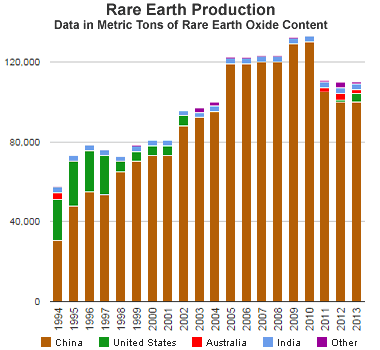
This chart shows a history of rare earth element production, in metric tons of rare earth oxide equivalent, between 1950 and 2015. It clearly shows the United States’ entry into the market in the mid-1960s when color television exploded demand. When China began selling rare earths at very low prices in the late-1980s and early-1990s, mines in the United States were forced to close because they could no longer make a profit. When China cut exports in 2010, rare earth prices skyrocketed. That motivated new production in the United States, Australia, Russia, Thailand, Malaysia, and other countries.


What Are Rare Earth Elements (REEs)?

Rare earth elements are a group of seventeen chemical elements that occur together in the periodic table (see image at right). The group consists of yttrium and the 15 lanthanide elements (lanthanum, cerium, praseodymium, neodymium, promethium, samarium, europium, gadolinium, terbium, dysprosium, holmium, erbium, thulium, ytterbium, and lutetium). Scandium is found in most rare earth element deposits and is sometimes classified as a rare earth element. The International Union of Pure and Applied Chemistry includes scandium in their rare earth element definition.

The rare earth elements are all metals, and the group is often referred to as the “rare earth metals.” These metals have many similar properties and that often causes them to be found together in geologic deposits. They are also referred to as “rare earth oxides” because many of them are typically sold as oxide compounds.
Uses of Rare Earth Elements

Rare earth metals and alloys that contain them are used in many devices that people use every day such as computer memory, DVDs, rechargeable batteries, cell phones, catalytic converters, magnets, fluorescent lighting and much more.

During the past twenty years, there has been an explosion in demand for many items that require rare earth metals. Twenty years ago there were very few cell phones in use, but the number has risen to over 7 billion in use today. The use of rare earth elements in computers has grown almost as fast as cell phones.

United States Usage
(2015 data from USGS)
Chemical Catalysts 60%
Metallurgy & Alloys 10%
Ceramics and Glass Making 10%
Glass Polishing 10%
Other 10%

Many rechargeable batteries are made with rare earth compounds. Demand for the batteries is being driven by demand for portable electronic devices such as cell phones, readers, portable computers, and cameras.

Several pounds of rare earth compounds are in batteries that power every electric vehicle and hybrid-electric vehicle. As concerns for energy independence, climate change and other issues drive the sale of electric and hybrid vehicles, the demand for batteries made with rare earth compounds will climb even faster.

Rare earths are used as catalysts, phosphors, and polishing compounds. These are used for air pollution control, illuminated screens on electronic devices, and the polishing of optical-quality glass. All of these products are expected to experience rising demand.

Other substances can be substituted for rare earth elements in their most important uses; however, these substitutes are usually less effective and costly.

From the 1950s until the early 2000s, cerium oxide was a very popular lapidary polish. It was inexpensive and very effective. The recent price increases have almost eliminated the use of cerium oxide in rock tumbling and the lapidary arts. Other types of polish, such as aluminum and titanium oxide, are now used in its place.
Critical Defense Uses

Rare earth elements play an essential role in our national defense. The military uses night-vision goggles, precision-guided weapons, communications equipment, GPS equipment, batteries and other defense electronics. These give the United States military an enormous advantage. Rare earth metals are key ingredients for making the very hard alloys used in armored vehicles and projectiles that shatter upon impact.

Substitutes can be used for rare earth elements in some defense applications; however, those subsitutes are usually not as effective and that diminishes military superiority. Several uses of rare earth elements are summarized in the table below (5).

Defense Uses of Rare Earth Elements
Lanthanum night-vision goggles
Neodymium laser range-finders, guidance systems, communications
Europium fluorescents and phosphors in lamps and monitors
Erbium amplifiers in fiber-optic data transmission
Samarium permanent magnets that are stable at high temperatures
Samarium precision-guided weapons
Samarium “white noise” production in stealth technology


Are These Elements Really “Rare”?

Rare earth elements are not as “rare” as their name implies. Thulium and lutetium are the two least abundant rare earth elements – but they each have an average crustal abundance that is nearly 200 times greater than the crustal abundance of gold (1). However, these metals are very difficult to mine because it is unusual to find them in concentrations high enough for economical extraction.

The most abundant rare earth elements are cerium, yttrium, lanthanum and neodymium (2). They have average crustal abundances that are similar to commonly used industrial metals such as chromiumnickelzinc, molybdenum, tin, tungsten andlead (1). Again, they are rarely found in extractable concentrations.
History of Rare Earth Production and Trade

Pre-1965

Before 1965 there was relatively little demand for rare earth elements. At that time, most of the world’s supply was being produced from placer deposits in India and Brazil. In the 1950s, South Africa became the leading producer from rare earth bearingmonazite deposits. At that time, the Mountain Pass Mine in California was producing minor amounts of rare earth oxides from a Precambrian carbonatite.

Color Television Ignites Demand

The demand for rare earth elements saw its first explosion in the mid-1960s, as the first color television sets were entering the market. Europium was the essential material for producing the color images. The Mountain Pass Mine began producing europium from bastnasite, which contained about 0.1% europium. This effort made the Mountain Pass Mine the largest rare earth producer in the world and placed the United States as the leading producer.

China Enters the Market

China began producing noteable amounts of rare earth oxides in the early 1980s and became the world’s leading producer in the early 1990s. Through the 1990s and early 2000s, China steadily strengthened its hold on the world’s rare earth oxide market. They were selling rare earths at such low prices that the Mountain Pass Mine and many others throughout the world were unable to compete and stopped operation.

Defense and Consumer Electronics Demand

At the same time, world demand was skyrocketing as rare earth metals were designed into a wide variety of defense, aviation, industrial and consumer electronics products. China capitalized on its dominant position and began restricting exports and allowing rare earth oxide prices to rise to historic levels.

China as the Largest Rare Earth Consumer

In addition to being the world’s largest producer of rare earth materials, China is also the dominant consumer. They use rare earths mainly in manufacturing electronics products for domestic and export markets. Japan and the United States are the second and third largest consumers of rare earth materials. It is possible that China’s reluctance to sell rare earths is a defense of their value-added manufacturing sector.

China’s Apex of Production Dominance?

The Chinese dominance may have peaked in 2010 when they controlled about 95% of the world’s rare earth production and prices for many rare earth oxides had risen over 500% in just a few years. That was an awakening for rare earth consumers and miners throughout the world. Mining companies in the United States, Australia, Canada and other countries began to reevaluate old rare earth prospects and explore for new ones.

High prices also caused manufacturers to do three things: 1) seek ways to reduce the amount of rare earth elements needed to produce each of their products; 2) seek alternative materials to use in place of rare earth elements; and, 3) develop alternative products that do not require rare earth elements.

This effort has resulted in a decline in the amounts of rare earth materials used in some types of magnets and a shift from rare earth lighting products to light-emitting diode technology. In the United States, the average consumption of rare earths per unit of manufactured product has decreased but the demand for more products manufactured with rare earth elements has increased. The result has been higher consumption.

China Buying Resources Outside of China

Chinese companies have been purchasing rare earth resources in other countries. In 2009 China Non-Ferrous Metal Mining Company bought a majority stake in Lynas Corporation, an Australian company that has one of the highest outputs of rare earth elements outside of China. They also purchased the Baluba Mine in Zambia.

Rare Earth Production Outside of China

Mines in Australia began producing rare earth oxides in 2011. In 2012 and 2013 they were supplying about 2% to 3% of world production. In 2012, the Mountain Pass Mine came back into production and the United States produced about 4% of the world’s rare earth elements in 2013. India has been producing about 3% of the world’s supply for the past decade. Indonesia, Russia, Nigeria, North Korea, Malaysia, and Vietnam are minor producers [3].

As of 2013 rare earth assessments were underway in Australia, Brazil, Canada, China, Finland, Greenland, India, Kyrgyzstan, Madagascar, Malawi, Mozambique, South Africa, Sweden, Tanzania, Turkey, and Vietnam [2]. Some of these might result in additional production.

The United States Geological Survey estimates that although China is the world-leader in rare earth production they only control about 50% of the world’s reserves. This provides an opportunity for other countries to become important producers now that China is not selling rare earth materials below the cost of production.

Dangers of a Dominant World Producer

Supply and demand normally determine the market price of a commodity. As supplies shrink, prices go up. As prices go higher, those who control the supply are tempted to sell. Mining companies see high prices as an opportunity and attempt to develop new sources of supply.

With rare earth elements, the time between a mining company’s decision to acquire a property and the start of production can be several years or longer. There is no fast way to open a new mining property.

If a single country controls almost all of the production and makes a firm decision not to export, then the entire supply of a commodity can be quickly cut off. That is a dangerous situation when new sources of supply take so long to develop.

In 2010 China significantly restricted their rare earth exports. That was done to ensure a supply of rare earths for domestic manufacturing and for environmental reasons. This shift by China triggered panic buying and some rare earth prices shot up exponentially. In addition, Japan, the United States, and the European Union complained to the World Trade Organization about China’s restrictive rare earth trade policies.
World Rare Earth Mineral Resources

“Rare earths are relatively abundant in the Earth’s crust, but discovered minable concentrations are less common than for most other ores. U.S. and world resources are contained primarily in bastnäsite and monazite. Bastnäsite deposits in China and the United States constitute the largest percentage of the world’s rare-earth economic resources, while monazite deposits in Australia, Brazil, China, India, Malaysia, South Africa, Sri Lanka, Thailand, and the United States constitute the second largest segment.

Apatite, cheralite, eudialyte, loparite, phosphorites, rare-earth-bearing (ion adsorption) clays, secondary monazite, spent uranium solutions, and xenotime make up most of the remaining resources. Undiscovered resources are thought to be very large relative to expected demand.” Quoted from the United States Geological Survey’s Mineral Commodity Summary (2).
Rare Earth Element Outlook

The global demand for automobiles, consumer electronics, energy-efficient lighting, and catalysts is expected to rise rapidly over the next decade. Rare earth magnet demand is expected to increase, as is the demand for rechargeable batteries. New developments in medical technology are expected to increase the use of surgical lasers, magnetic resonance imaging, and positron emission tomography scintillation detectors.

Rare earth elements are heavily used in all of these industries, so the demand for them should remain high.

rare-earth-elements-periodic-table

REE Periodic Table: The Rare Earth Elements are the 15 lanthanide series elements, plus yttrium. Scandium is found in most rare earth element deposits and is sometimes classified as a rare earth element. Image by Geology.com.


 heavy-light-rare-earth-elements
The rare earth elements are often subdivided into “Heavy Rare Earths” and “Light Rare Earths.” Lanthanum, cerium, praseodymium, neodymium, promethium and samarium are the “light rare earths.” Yttrium, europium, gadolinium, terbium, dysprosium, holmium, erbium, thulium, ytterbium, and lutetium are the “heavy rare earths.” Although yttrium is lighter than the light rare earth elements, it is included in the heavy rare earth group because of its chemical and physical associations with heavy rare earths in natural deposits.

uses-of-rare-earth-elements

This chart shows the use of rare earth elements in the United States during 2013. Many vehicles use rare earth catalysts in their exhaust systems for air pollution control. A large number of alloys are made more durable by the addition of rare earth metals. Glass, granite, marble and gemstones are often polished with cerium oxide powder. Many motors and generators contain magnets made with rare earth elements. Phosphors used in digital displays, monitors and televisions are created with rare earth oxides. Most computer, cell phone and electric vehicle batteries are made with rare earth metals.


 pic Did You Know? Most of the scandium used in the United States goes into aluminum-alloy baseball bats and other sports equipment (3). Scandium is also used in semiconductors and specialty lighting.


Rare Earth Element Maprare-earth-element-map-380

In 2013, China produced about 90% of the world’s supply of rare earth element ores. The USGS Mineral Commodity Summary (2) reported production tonnages for Australia, the United States, India, Brazil, Russia, Vietnam and Malaysia. Rare earth element exploration and/or development is being done in Canada, South Africa, Thailand, Malawi, and Sri Lanka; however, production from those countries was insignificant during 2013.

rare-earth-element-production-chart

This chart shows China’s dominance in the production of rare earth elements between 1994 and 2012. The United States was a significant producer through the early 1990s, but low-priced materials being sold by China forced mines in the United States and other countries out of operation. As China limited exports and prices increased rapidly in 2009 and 2010, mines in Australia and the United States became active again. Graph by Geology.com using data from the United States Geological Survey.


World Mine Production and Reserves (2015 Estimates)
Country Production (Metric Ton) Reserves (Metric Ton)
United States 4,100 1,800,000
Australia 10,000 3,200,000
Brazil 22,000,000
China 105,000 55,000,000
India 3,100,000
Russia 2,500 ?
Thailand 2,100 not available
Malaysia 200 30,000
Other countries not available 41,000,000
World total (rounded) 110,000 140,000,000


wind-turbine Did You Know? Rare earth magnets are used in wind turbines. Some large turbines require two TONS of rare earth magnets. These magnets are very strong and make the turbines highly efficient. Rare earth magnets are used in turbines and generators in many alternative energy applications.


 rare-earth-prices Did You Know? Prices and demand for rare earth materials have risen dramatically over the past decade. China produces about 90% of the supply. Deposits in Australia and the United States are going back into operation, and exploration in many new areas is progressing.

rare-earth-oxides-usda

These rare earth oxides are used as tracers to determine which parts of a watershed are eroding (4). Clockwise from top center: praseodymium, cerium, lanthanum, neodymium, samarium, and gadolinium. Image by Peggy Greb, USDA image gallery.


oil-battery-car-istock Did You Know? Every hybrid-electric and electric vehicle has a large battery. Each battery is made using several pounds of rare earth compounds. The use of electric vehicles is expected to increase rapidly, driven by energy independence, climate change and other concerns. This will increase the demand for rare earth materials. Image © Mark Stay, iStockphoto.


cell-phones-istock Did You Know? Tiny amounts of rare earth metals are used in most small electronic devices. These devices have a short lifespan, and REE recycling is infrequently done. Billions are thrown away each year. Image © Bakaleev Aleksey, iStockphoto.

Link : http://geology.com/articles/rare-earth-elements/

India’s beach sand-mining industry set to prosper under private sector

India’s beach sand-mining industry set to prosper under private sector

Jaideep Prabhu Jul 14, 2016 15:16 IST

Beach-sand-deposit

With the strangulation of rare earth supplies by China, India’s beach sand-mining industry has received a fillip to develop and expand.

However, there are several hurdles: Government regulations aside, beach sand mining is a much misunderstood industry that has caused concern in the past. For example, the image of mining in the public mind involves massive trucks carrying off earth and large depressions in the ground caused by excavations. This is believed to damage not only the environment, but also the beauty of southern India’s beaches. Beach sand-mining is quite different in many respects, and it is an important industry whose development is vital not just for India’s economic health but also strategic interests.

One of the misconceptions about beach sand-mining is the assumption that it involves quarrying. This is patently false: Companies that operate in this field in southern Tamil Nadu, for instance, dredge only the top inch of beach sand. Any deeper, and they would be mining for silica, which is neither a rare earth mineral, nor of any use to the industry. The skimming is done every morning, usually between 4 pm and 12 pm; each day, the sea deposits fresh layers of rare earth minerals on the beaches and by evening, much of it is washed away if not harvested.

The source of these minerals, however, are the Ghats – these minerals are found in the rocks in quantities too small to extract profitably, but natural weathering erodes the deposits which make their way into streams and rivers and to the ocean. The breaking wave deposits the heavier minerals further up the beach but the back wave carries the lighter minerals ashore and deposits them closer to the water.

This partial sorting of minerals based on their weight explains the striations of colour that can be seen on the beach.

Of the superficial inch, somewhere between 70 and 80 percent of the sand collected is returned to the beach after a primary filtration process. Rare earths, as their name suggests, exist in very small quantities in the sand and most of the day’s collection is gangue material. This filtration is usually done very close to the mining area so that the volume of material transported to the factories is less. The collection is sifted through a trommel screen and then put through a concentrator unit that uses the principle of gravity to separate the heavy minerals from the sand.

Karan

Although there are several minerals that yield rare earth elements, the beaches of Odisha, Andhra Pradesh, Tamil Nadu and Kerala are more abundant in seven – garnet, ilmenite, leucoxene, monazite, rutile, sillimanite, and zircon. These ores, when processed, yield niobium, tantalum, titanium, thorium, and other elements important for a wide variety of industries such as electronics, energy, plastics, paints, construction, shipping, paper, and nuclear. China dominates the rare earths market with 97 percent of the exports but even at a meagre two percent, India is the second largest exporter of rare earths. With Beijing’s recent restrictions on rare earths exports, prices have increased and several countries such as Japan, France, and the United States are interested in the development of Indian rare earth deposits.

At the factory, the rare earth minerals are extracted using various techniques based on their physical properties. The raw material is sorted using only magnetism, conductivity, and gravity to separate the six or seven minerals. High tension and magnetic separators extract ilmenite, monazite, rutile, and garnet while zircon and sillimanite are separated by their specific gravity in spiral concentrators and wet tables. At no point are any chemicals used in the separation of these minerals though other ores occurring elsewhere may require it, such as separating sillimanite from quartz. The extracted minerals may be further processed based on quality; for example, electrostatic plate separators, air tables, cross-belt magnetic separators, very high intensity magnetic separators, and rare earth drum separators can refine the minerals using the same principles that were used to extract them.

Beach-sand-mining-process

The entire process can be made to have a low impact on the environment.

For example, VV Mineral, a Thoothukudi-based firm, uses the natural Tamil Nadu sun to dry the minerals rather than use large, diesel-powered kilns. Furthermore, the water used in the separation process is treated and recycled. What few tailings are generated are dumped into a small pond of recycled water where the sand bed will act as a natural filter. VV Mineral, India’s largest garnet and ilmenite exporter, has also won several awards and certifications for its environmentally friendly mining processes. Furthermore, its corporate social responsibility involves employment of local youth, health coverage, education, and several other services to the area.

Admittedly, processing rare earths to obtain their elements is a chemical process. However, this is different from beach sand mining and only few of the firms, usually public sector undertakings, involved in one engage with the other.

The government is now considering further opening up the mining of rare earth minerals to the private sector.

This is to reduce dependence on foreign imports necessitated by the abysmal failure of PSUs to develop and expand domestic mines and processing plants. The expansion of private sector presence from lighter rare earths to heavier rare earths is one of several important steps India must take towards achieving capabilities across the entire chain of products. With good geological data, existing firms may wish to expand their portfolios or new players may be interested in entering the market.

A market-oriented policy would have a strategic international impact in that purchasers will have an alternative vendor to China. Given the importance of some of these materials to sensitive fields, India’s value as a partner will increase and allow the Delhi to leverage its ores for important technology and other benefits. Rather than cast accusing glances at the beach sand mining industry, it must be incorporated into the ‘Make in India’ national strategy for self-reliance.

Link : http://m.firstpost.com/business/indias-beach-sand-mining-industry-set-to-prosper-under-private-sector-2893298.html


Shri. Balvinder Kumar, IAS, Secretary, Ministry of Mines message in National Conclave on Mines and Minerals at Raipur

The Mining Sector has a pivotal role to play in the “Make in India” Vision of the Prime Minister. With the rapid growth of the Indian Economy anticipated in the years to come, there is a renewed thrust in infrastructure and manufacturing sectors, which would require ensured and timely supply of minerals as basic raw materials. The reforms undertaken would ensure that the matching growth of the mining sector is sustainably achieved for giving impetus to the “Make in India” Program.

Article About Beach Mineral Policy published in TOI

For Policy Coherence on Beach Sand Mining

It is most unfortunate that myopic policy and dated rules keep the beach sand minerals (BSM) sector hugely constrained and functioning well below potential despite their high and rising strategic and commercial importance. BSM are a group of deposits, namely ilmenite, rutile, zircon, monazite, leucoxene, garnet and sillimanite, found across beaches in peninsular India. But they all continue to be misclassified as “atomic minerals“ in the law, with the result that routine approvals take 7-8 years, with the green signal required from as many as 28 departments both at the Centre and states.Some 65-70% of BSM constitute ilmenite, which yields strong-metal titanium used to make paint and tough metal alloys.

India has about 30% of global reserves of BSM, but the production-to-reserve ratio here has been the lowest in the world at 0.002; the sector was opened up to private sector participation as late as 1998. What is worse, in a back to the future move, the Atomic Minerals Concession Rules, 2016, propose to abruptly restrict BSM mining only for the public sector if the deposits have equal or more than 0.75% monazite. This is draconian and worse.

Thankfully , since 2007, ilmenite, rutile, zircon and leucoxene are no longer officially classified as atomic minerals. Yet, the Mines and Minerals (Development and Regulation) Amendment Act, 2015, has not incorporated the change. This needs to be done pronto. We clearly need proactive regulation and oversight of BSM. There is no reason why , say, the output of ilmenite here remain in the low single digits of global production. A business-like policy framework can result in billions of dollars in output and value-added and give rise to huge employment. Besides, BSM do not require conventional mining, blasting or trenches, etc, as the sand is duly restored.

ET