


Tag: Rutile
Some FAQ about mining in GST – Govt., clarification published for our members reference
இந்திய கனிம வளத்தில் இலங்கை கொழுக்கிறது

நன்றி
வணக்கம் இந்தியா
03/08/2017
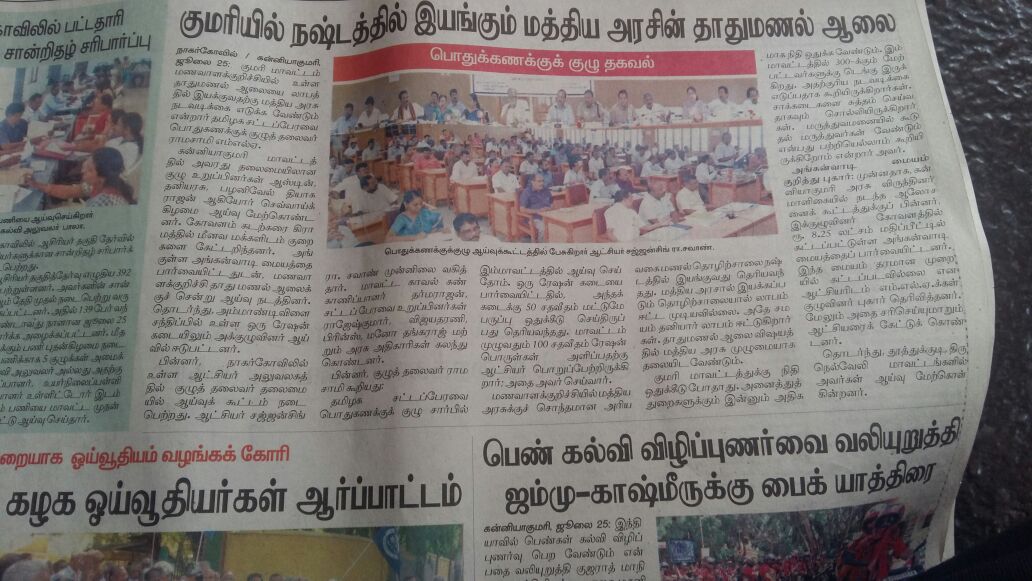
நஷ்டத்தில் இயங்கும் மத்திய அரசின் தாதுமணல் ஆலை: பொதுக்கணக்குக் குழு தகவல்
Ilmenite export ban hits paint Industry
Ilmenite export ban hits paint Industry
By Trevor Paul, New Delhi
18/05/2017
Any picture depicting India would have hues of Holi and vibrant colours of the bazaar. So it is surprising that the ban of ilmenite exports has been done with a black and white view thereby robbing the Indian paint industry of its sheen.
When Prime Minister Narendra Modi launched the Swachh Bharat initiative, the paint industry rejoiced. Clean up and do what? After all, they would have surmised, if surroundings are clean and well painted the chances of it staying clean is a lot higher. Instead the Indian paint industry was hit hard by the sudden Government ban on ilmenite exports.
The Government obviously has viewed ilmenite as a resource that does not replenish and has not taken into account the massive revenue loss and India’s standing in the international arena and not to forget that it constitutes a severe setback to the Make in India initiative.
Post the ban on ilmenite exports, the Indian paint companies were forced to announce a steep price increase of all their products. While the big brands could afford to increase the prices and handle low demand the worst hit are the nearly 2,500 medium and small Indian paint companies.
There are around 300 to 400 ingredients that go into making decorative paints. Out of this, the major raw material, TiO2, a white pigment, constitutes about 12-35% and is derived from ilmenite. Continuing technological inventions and environmental regulations make the inventory even larger. While there are thousands and thousands of coating manufacturers around the globe, TiO2 producers are comparatively few in numbers.
More than 60 percent of the input costs of paint manufacturing go into procuring raw materials. Since the high demand for raw materials makes the supply irregular, the paint manufacturer (particularly the small player) has to plan ahead and keep stocks. As many of the raw materials are to be imported, the picture gets even more complicated.
Of the imports, the pigment Titanium Dioxide (TiO2) is of major interest due to the following reasons. The annual Indian requirement for TiO2 is 1,75,000 metric tonnes whereas the domestic production is only 30,000 metric tonnes. This forces Indian paint manufacturers to import 1,45,000 metric tonnes of TiO2 every year, spending out huge amounts.
The irony is as below.
TiO2 is extracted from a beach sand mineral, ilmenite. The ilmenite beach sand reserves found on the coasts of India are replenishable in nature. Around 15 licence requests from private players for producing TiO2 locally are pending with the Government. The licence raj reigns supreme and no approvals are forthcoming.
TiO2 CONSUMPTION
Many of the countries where the TiO2 manufacturers are located do not have ilmenite reserves. Indian miners from Tamil Nadu and Andhra Pradesh and a public sector company from Kerala account for 15% of the world TiO2 feedstocks and were supplying to various pigment manufacturers around the globe.
Due to the growing domestic paint market, which is estimated to around Rs 20,000 crore, the consumption for TiO2 is increasing by leaps and bounds.
But why is the supply of TiO2 suddenly a question mark?
The last nail on the vexatious issue was hammered in when the ban on ilmenite export was enforced in 2016. One could see a sharp price rise in TiO2 after the ban. In the last six months alone, the global prices have increased up to 50 percent. This is because of the fact that in the absence of Indian ilmenite, the TiO2 (overseas) manufacturers were forced to spend more on the diminishing ilmenite supply from other countries and have increased their product prices. A sudden shortage of 10% ilmenite supply in the world market has led to a steep increase of the raw material price and this has affected the pigment market, says a recent report. The price increase has forced Indian consumers to shell out Rs 950 crore additionally, the major chunk of which is foreign exchange.
EFFECT OF THE BAN
The effect of the ban on the export is multifold. Small and medium scale paint manufacturers find it very difficult to make profits. The middle class and rural people who are currently the major consumers of decorative paints are unable to bear any price increase. The Government on its side loses mining royalty, export duty and foreign exchange. The workers involved in mining, processing and logistics operations were also rendered jobless.
Even as we debate a great future it is time the Government looks at the opportunity in ilmenite. It would do well to approve all the pending licence applications to manufacture TiO2 locally in large scale by removing the ban. This will surely help in capacity building and would go a long way in building confidence in the Make in India programme and for a bright, clean and colourful India in the years to come.
Link : https://bureaucracytoday.com/latestnews.aspx?id=183092
Our objection to EJatlas and their reply
From: Joan Martinezalier
Date: Mon, Apr 17, 2017 at 1:46 PM
Subject: from the EJAtlas, “Sand mining in Tamil Nadu”
To: president@beachminerals.org, EJOLT Project <ejoltmap@gmail.com>
Thank you for your message and for the information regarding this case. We have withdrawn the case on Sand mining in Tamil Nadu from the EJAtlas, in order to rewrite it as two separate cases, i.e. separating conflicts on sand and gravel mining in rivers and beaches as a raw material for the building industry,
and (as a separate issue) possibly conflicts on sand mining in beaches for ilmenite and other materials (if they exist in Tamil Nadu, as they exist in other countries – we have to do more research this). For instance, in the EJAtlas we have cases on conflictive ilmenite mining in sand dunes in Madagascar, South Africa (https://ejatlas.org/conflict/
Sincere apologies for the incovenience caused. You are right to complain. We shall take carefully into account all the information you have sent. With out best wishes,
———- Forwarded message ———-
From: Pauldurai Perumal <president@beachminerals.org>
Date: Mon, Apr 17, 2017 at 11:48 AM
Subject: Objection to the article “Illegal Sand Mining in rivers and beaches in Tamilnadu, India” published on 12.04.2017
To: leah.tmer@gmail.com, ejoltp@gmail.com
To,The EditorEnvironmental Justice Atlas
Sir,
We draw your attention to the article “Illegal Sand Mining in rivers and beaches in Tamilnadu, India” published on 12.04.2017, in your website. The author has grossly mixed up two separate and completely different activities namely River sand mining and Beach sand minerals mining clearly indicating complete lack of understanding of the topics. Further, the article is based on speculative media reports grossly misleading the public at large.
We present below the facts regarding Beach sand mineral mining which will help you understand the truth and you will realise that the accusations made in the published article against beach sand mining are malafide, false and imaginary intending to discredit the business and bring disrepute to people engaged in this business.
1) Beach sand mineral mining is a permitted activity in the coastal regions as per Law. In fact, Beach Sand Mineral mining activity has been in existence for several decades in Tamilnadu and public sector company Indian Rare Earths ( IREL) was the first entrant into this field. Subsequently other private companies also entered into this activity and presently both public sector and many private companies are engaged in this BSM business in Tamilnadu.
2) The article contains several sweeping and irresponsible statements like “Laws remain in paper only”, Environmental clearances through bribery”, “ Violations of regulations ” etc. All these statements are false and baseless and as you can read below, there are Rules governing these minerals and there are various approvals required to carry out Beach Sand mineral mining.
We wish to add the VV Minerals has all these necessary approvals and has been carrying out its operations in accordance with the Law.
3) Beach sand minerals (garnet, ilmenite , zircon, rutile , sillimanite , monazite) are classified as major minerals and placed in Schedule I- Part B – Atomic minerals in the Mines and Minerals Development and Regulation (MMDR) Act. Mining leases are granted by the State Government after getting the approval from the Central Government. In addition, there are several clearances and approvals obtained from various statutory and regulatory authorities as follows:
- a) Clearance from Ministry of Enviornmnet and Forest (MOEF), Govt. Of India and also the State Pollution control board
- b) Licence from Atomic Energy Regulatory Board (AERB) for operating the BSM plants. There are regular inspections by AERB and mandatory submission of regular returns to AERB to ensure compliance.
- c) Mining Plan Approval by Indian Bureau of Mines (IBM) and Atomic Minerals Directorate (AMD), Govt of India. Mining leases are granted only after submission of Approved Mining Plan. In addition there are regular inspections by IBM and submission of regular returns to these departments to ensure compliance.
- d) Approval from Directorate of Mines Safety (DGMS), Ministry of Labour, Govt. of India to ensure Safety in Beach Sand Mines. The BSM mines are subjected to Regular Inspections by DGMS and have to submit statutory returns.
- e) Directorate of Geology & Mining (DGM), Tamil Nadu State Govt. is the authority which grants mining leases. Transport permits are obtained from the district officer of DGM after royalty payment. The district officers of DGM issue permits after verification of the mine sites.
4) The statement “Vaikundarajan doing illegal mining worth 96,000- crore in the last decade” is a completely false and baseless accusation without any supporting facts. Please ref para 5: http://www.beachminerals.org/wild-allegations-leveled-v-v-mineral-v-sundaram-ias-found-wrong-motive-envy-vindictive-far-away-truth/. As mentioned above, VV Minerals owned by Vaikundarajan has secured all necessary approvals to conduct its business . Further, there are public sector and other private companies engaged in this business and Vaikundarajan is being singled out in these accusations by certain journalists like Sandhya Ravishankar due to personal animosity and ulterior motives. The article in your website is also based on these false accusations in media to troll Vaikundarajan and thus the media is misusing their freedom of press to malign him and his business.
5) The article also purports to create misconceptions and fears about beach sand mining. These misconceptions are imaginary with no scientific basis. Beach sand mineral mining is a very environmentally friendly activity and the following highlights of this activity will dispel any negative bias towards beach sand mining.
a) In the coastal tracts beach sand minerals are excavated from shallow pits varying in depth from less than a foot to about a few feet depth. The excavation of beach sand is done manually without deployment of any heavy earth moving equipment and so there is no air or noise pollution.
b) After extraction of the valuable minerals, the barren sand is backfilled into the excavations. Thus, the land is reclaimed and restored to its original topography.
c) the deposition of the beach sand minerals onto the beach is a continuous process replenished by natural geologic processes and hence there is no disturbance to the beach topography by this activity.
d) All the excavations are above the water table and so this activity does not disturb the groundwater table. Hence there is no impact on the groundwater resources or its quality.
6. Sandhya Ravishankar is paid news reporter engaged by one illegal mining gang. You can find more about her in http://vetri3337.blogspot.in/ , http://vvmemp.blogspot.in/ , http://niyasah01.blogspot.in/
Please publish the same in your website.
Yours Truly
N.Pauldurai @ Perumal
Unearthing India’s Sub-Surface Natural Resources
Mining Industry is in danger – Part-5
The Corporate Income Tax rates in India are very high compared to the other major mining countries. The effective tax rate is around 34.61% for income exceeding Rs. 100 million for the domestic company and for the foreign company the rate is 43.26% (KPMG, 2015). A minimum alternative tax (MAT) is levied at 18.5% of the adjusted profit of the companies where the tax payable is less than 18.5% of their book value. The government has also started charging “carbon tax” which would add to the percentage furthermore.
Mining sector is capital intensive and utilizes specialised mine equipment that is usually imported. Higher import duty on mine equipment has a direct negative impact on mine projects, especially in the initial years of the mine project. Even the royalty rates in India are at the highest level. The rate of royalties on iron ore is 15% and that on coal is 14% which is way more than the other countries of the world .
International Comparison of Corporate Tax Rates: 2015
| Country | Corporate Tax Rate |
| Argentina | 35% |
| Australia | 30% |
| Brazil | 34% |
| Canada | 26.5% |
| Chile | 22.5% |
| China | 25% |
| Germany | 29.65% |
| India | 34.61% |
| Indonesia | 25% |
| Mexico | 30% |
| Peru | 30% |
| Philippines | 30% |
| Russia | 20% |
| South Africa | 28% |
| Tanzania | 30% |
| Ukraine | 18% |
| United Kingdom | 23% |
| United States | 40% |
Mining Industry is in danger – Part-4
The Risk involved in Mining has shifted towards Mining Business and Return towards Government.
The case was other way around few years back as shown in the figure below:
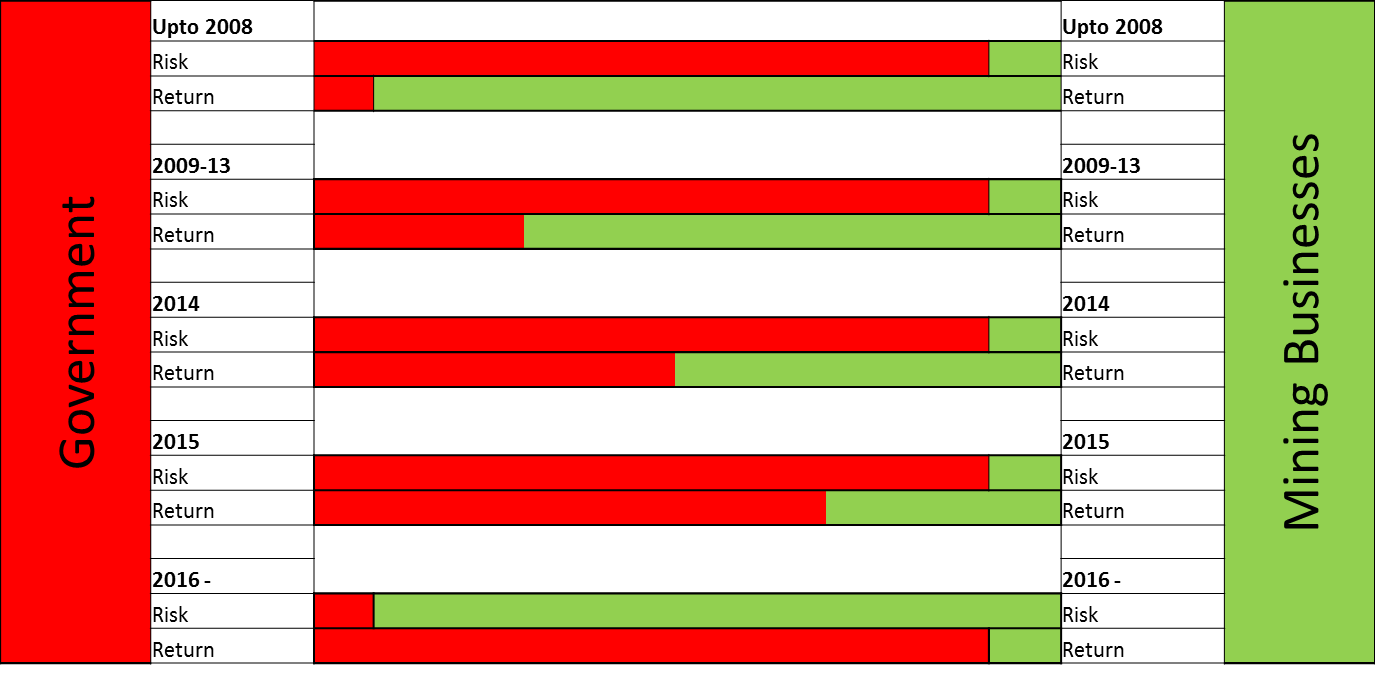
From the above mentioned, facts it is very clear that the margin for doing Business in Mining has been substantially reduced. It would be an impetus for Indian Mining Industry if the overall taxation is reduced to around 40% (Global Average).It may also be mentioned that after the enactment of the amended act, out of 42 mines only one dozen mines could be allocated through auction. No fresh mine has come to the production as of now.
Mining Industry is in danger – Part-3
After amendment of new mining law, the overall tax rate is increased.
Graph showing increase in overall Taxation after enactment of MMDR Amendment Act, 2015
