


Category: Media News
இந்திய கனிம வளத்தில் இலங்கை கொழுக்கிறது

நன்றி
வணக்கம் இந்தியா
03/08/2017
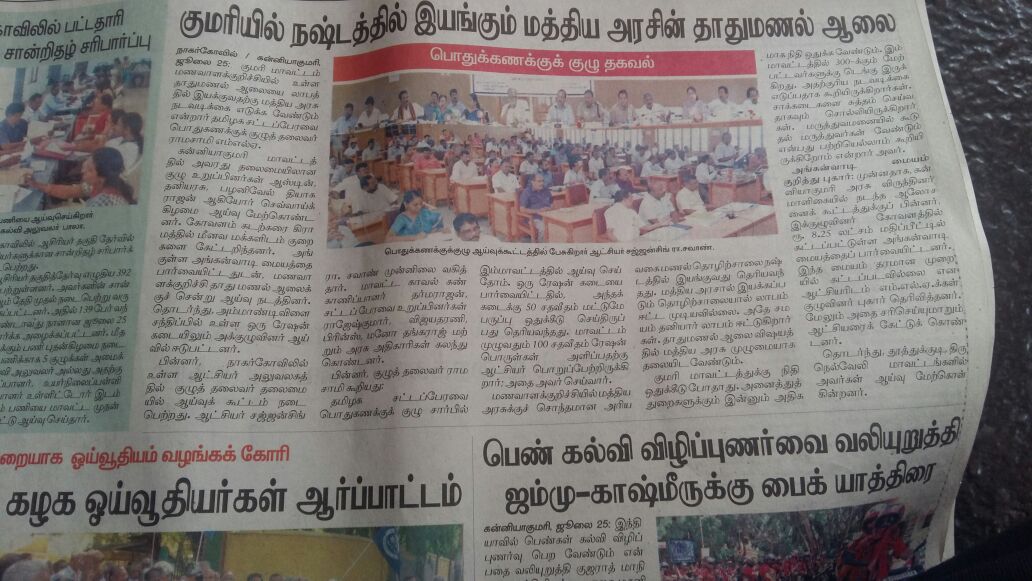
நஷ்டத்தில் இயங்கும் மத்திய அரசின் தாதுமணல் ஆலை: பொதுக்கணக்குக் குழு தகவல்
Minerals Essential In our Life
Ilmenite export ban hits paint Industry
Ilmenite export ban hits paint Industry
By Trevor Paul, New Delhi
18/05/2017
Any picture depicting India would have hues of Holi and vibrant colours of the bazaar. So it is surprising that the ban of ilmenite exports has been done with a black and white view thereby robbing the Indian paint industry of its sheen.
When Prime Minister Narendra Modi launched the Swachh Bharat initiative, the paint industry rejoiced. Clean up and do what? After all, they would have surmised, if surroundings are clean and well painted the chances of it staying clean is a lot higher. Instead the Indian paint industry was hit hard by the sudden Government ban on ilmenite exports.
The Government obviously has viewed ilmenite as a resource that does not replenish and has not taken into account the massive revenue loss and India’s standing in the international arena and not to forget that it constitutes a severe setback to the Make in India initiative.
Post the ban on ilmenite exports, the Indian paint companies were forced to announce a steep price increase of all their products. While the big brands could afford to increase the prices and handle low demand the worst hit are the nearly 2,500 medium and small Indian paint companies.
There are around 300 to 400 ingredients that go into making decorative paints. Out of this, the major raw material, TiO2, a white pigment, constitutes about 12-35% and is derived from ilmenite. Continuing technological inventions and environmental regulations make the inventory even larger. While there are thousands and thousands of coating manufacturers around the globe, TiO2 producers are comparatively few in numbers.
More than 60 percent of the input costs of paint manufacturing go into procuring raw materials. Since the high demand for raw materials makes the supply irregular, the paint manufacturer (particularly the small player) has to plan ahead and keep stocks. As many of the raw materials are to be imported, the picture gets even more complicated.
Of the imports, the pigment Titanium Dioxide (TiO2) is of major interest due to the following reasons. The annual Indian requirement for TiO2 is 1,75,000 metric tonnes whereas the domestic production is only 30,000 metric tonnes. This forces Indian paint manufacturers to import 1,45,000 metric tonnes of TiO2 every year, spending out huge amounts.
The irony is as below.
TiO2 is extracted from a beach sand mineral, ilmenite. The ilmenite beach sand reserves found on the coasts of India are replenishable in nature. Around 15 licence requests from private players for producing TiO2 locally are pending with the Government. The licence raj reigns supreme and no approvals are forthcoming.
TiO2 CONSUMPTION
Many of the countries where the TiO2 manufacturers are located do not have ilmenite reserves. Indian miners from Tamil Nadu and Andhra Pradesh and a public sector company from Kerala account for 15% of the world TiO2 feedstocks and were supplying to various pigment manufacturers around the globe.
Due to the growing domestic paint market, which is estimated to around Rs 20,000 crore, the consumption for TiO2 is increasing by leaps and bounds.
But why is the supply of TiO2 suddenly a question mark?
The last nail on the vexatious issue was hammered in when the ban on ilmenite export was enforced in 2016. One could see a sharp price rise in TiO2 after the ban. In the last six months alone, the global prices have increased up to 50 percent. This is because of the fact that in the absence of Indian ilmenite, the TiO2 (overseas) manufacturers were forced to spend more on the diminishing ilmenite supply from other countries and have increased their product prices. A sudden shortage of 10% ilmenite supply in the world market has led to a steep increase of the raw material price and this has affected the pigment market, says a recent report. The price increase has forced Indian consumers to shell out Rs 950 crore additionally, the major chunk of which is foreign exchange.
EFFECT OF THE BAN
The effect of the ban on the export is multifold. Small and medium scale paint manufacturers find it very difficult to make profits. The middle class and rural people who are currently the major consumers of decorative paints are unable to bear any price increase. The Government on its side loses mining royalty, export duty and foreign exchange. The workers involved in mining, processing and logistics operations were also rendered jobless.
Even as we debate a great future it is time the Government looks at the opportunity in ilmenite. It would do well to approve all the pending licence applications to manufacture TiO2 locally in large scale by removing the ban. This will surely help in capacity building and would go a long way in building confidence in the Make in India programme and for a bright, clean and colourful India in the years to come.
Link : https://bureaucracytoday.com/latestnews.aspx?id=183092
கருஞ்சிகப்பு நிறமாக மாறிய திருச்செந்தூர் கடல்..
திருச்செந்தூர் கடல் பகுதி நேற்று மாலை முதல் கருஞ் சிவப்பு நிறமாக மாறிவந்தது. இதனால் முருகன் கோயிலுக்கு வந்த பக்தா்கள் கடலில் குளிக்க பரவசம் அடைந்துள்ளனர்.

என்ன இந்த மாற்றத்திற்கு காரணமாக இருக்கலாம் என தெரியவில்லை வழக்கமாக கடலின் கரை பகுதி நீலநிறமாகவும், ஆழ்கடல் பகுதி பச்சை நிறமாகவும் இருக்கும் ஆனால் நேற்று மாலை 3 மணி அளவில் திருச்செந்தூர் கடலில் கருஞ்சிவப்பு நிறத்தில் போன்று பரவி காணப்பட்டது.
வள்ளி குகை அருகில் இருந்து கடலில் கண்ணுக்கு எட்டிய தூரம் வரை இப்படி இதையடுத்து பக்தர்கள் யாரும் கடலில் குளிக்க அனுமதிக்கப்படவில்லை. இதற்குக் காரணம், ஆழ்கடலில் காணப்படும் ஒருவகை பாசி, தற்போது கடலுக்கு மேல் வந்துள்ளதாகக் கூறப்படுகிறது.இது வரையில் இப்படி நடத்தும் இல்லை!!!!
Source : http://tamil.oneindia.com/news/tamilnadu/thiruchendur-sea-water-turnes-dark-red-278208.html
http://www.dinanewspaper.com/2017/03/tiruchendur.html
Kerala Assembly speaker bats for mineral beach sand mining, LNG pipeline
Kerala Assembly speaker bats for mineral beach sand mining, LNG pipeline
TNN | Feb 22, 2017, 01.49 PM IST

KANNUR: Kerala Legislative Assembly speaker P Sreeramakrishnan has said if “we had permitted mining of mineral beach sand, we would have become wealthier but we missed the opportunity”.
“The opposition against the mining was the environmental issues in one or two panchayats, but instead of addressing the problems there and permitting mining in other places, we spoiled the opportunity by opposing it, which could have made us wealthier than Qatar,” he said inaugurating the seminar on the development of Kannur Assembly constituency, organised under the aegis of KILA, here on Tuesday.
Though people of all political affiliations should come forward to join hands in development, development also has a politics beyond party affiliations, and it is natural to have politics in priorities while formulating the development policy, he reminded. Nowadays, in the name of development, there is a corporate tendency to bring all the people’s representatives under their fold irrespective of politics and we have to be careful about it, he added.
At the same time, the speaker also said the opposition against the proposed LNG pipeline between Kochi and Mangaluru is not justified and the plant in Kochi built with an expense of Rs 20000 crore is not yet functional because of this.
Observing that our attitudes about development should change, and also the mistakes should be rectified, the Speaker said the process of development is of multi-level and it is time to evaluate the development in Kerala, which is 60 years old now.
He also said there are two diametrically opposite arguments about the Kerala model development. One group says there is nothing called Kerala model while the other says Kerala model is the ultimate, but these extremist arguments are wrong, he added.
“Kerala model is something which astonished the whole world but it is wrong to say that it is the ultimate, and we have to improve further,” he pointed out, and added that we should ask ourselves if we have succeeded in carrying forward the message put forth by the people’s planning programme.
We are much behind of others in manufacturing value-added products, opined the Speaker, who pointed towards the strides made by Sri Lanka in making value-added products from coconut. Similarly, though we are top producers of rubber, we do not have any major rubber product industry here, said Sreeramakrishnan.
Kannur MLA and minister for ports Ramachandran Kadannappally presided.
The seminar was based on a draft document on the overall development of the constituency. Based on the 12 group level discussions in the seminar, the draft would be finalised and then various government agencies would be approached to get funds for the projects, said the organisers.
TN granite mining loss calculation unscientific, federation says
CHENNAI: When the total value of India’s granite exports over a period of 17 years worked out to a mere Rs 52,000 crore, how can the notional loss suffered by illegal granite mining in Madurai district alone would work out to Rs 1 lakh crore, an association of granite mining companies has asked.
When a PIL relating to illegal mining of granite in Madurai district, for which the first bench of Madras high court had appointed senior IAS officer U Sagayam as legal commissioner, came up for further hearing on Thursday, P Wilson, senior advocate for the Federation of Indian Granite and Stone Industry, said such astronomical figures had been arrived at on the basis of unscientific data.
The first bench headed by Chief Justice Sanjay Kishan Kaul on September 11, 2014 handpicked IAS officer U Sagayam and appointed him as legal commissioner to go into the issues raised in a PIL filed by social activist K R ‘Traffic’ Ramaswamy. After it was clarified that Sagayam would go into violations and illegal mining in Madurai district alone, he filed his first report on November 24, 2015. Granite mining in the district came to a halt because of the case.
Now, the 1,200-member federation, registered in Karnataka, has come to court saying only between 10% and 15% of the total quarried granite would be sale-worthy. Though this is the national and international standard, the legal commissioner had proceeded on the premise that about 80% of the granite was sale-worthy, Wilson said.
Noting that for 17 years from 1996 to 2013, India had exported granite to 150 countries and the total value of the transactions was Rs 52.372 crore, Wilson said internal domestic consumption was very negligible. While so, the legal commissioner had quoted astronomical figures of loss because the calculations was on the basis of 80%-85% sale-worthiness.
Seeking to implead itself, besides the government of India entities such as Geological Survey of India, Indian Bureau of Mines, National Institute of Rock Mechanics, Wilson said only then the exact alleged loss could be ascertained. The court should not proceed merely on the basis of the legal commissioner’s reports, he said.
Advocate general of Tamil Nadu said the state government had not yet taken any decision in this regard and added that it had written to the Centre to find out as to what exactly was the value and loss. On receiving the inputs, a final report would be filed in the court, he said.
The bench comprising Chief Justice Kaul and Justice R Mahadevan posted the matter to January 11, 2017 for further hearing.
‘India not realising potential of rare earth industry’
‘India not realising potential of rare earth industry’
NEW DELHI: The Indian rare earth industry, potentially worth Rs 90,000 crore in annual turnover, lies wasted and underused, according to industry representatives.
As per estimates by experts belonging to the Beach Minerals Producers Association, the rare earth mineral downstream industry can net a capital employment of about Rs 121,000 crore, including Rs 50,000 crore worth of foreign exchange.
Rare earths are a special class of 17 elements that have extensive uses across various industries including computer and IT, clean energy systems, healthcare, defence production, advanced transportation services and many others.
Significant rare earths minerals found in India include ilmenite, sillimanite, garnet, zircon, monazite and rutile, collectively called Beach Sand Minerals (BSM). India has almost 35 per cent of the world’s total beach sand mineral deposits.
Their importance lies in their unique electronic, optical and magnetic characteristics, which cannot be matched by any other metal or synthetic substitute.
However, the industry in India has barely registered momentum.
“In 1998, they started freeing up the industry and in 2006, those minerals were taken off the prescribed substances list and for some reason, they have recently been put back on. So, the country has actually gone backwards. There is no justification,” said Grant Smith, director-overseas operations at V V Minerals. “No one is getting the licences. It has been reserved specifically for PSUs through the DAE (department of atomic energy). So, at the moment, it is only the IndiaRare Earths and the Kerala operations.”
Indian Rare Earths Ltd (IRE) is operating the mineral sands separation plant at Chavara in Kerala to produce some rare earth minerals. Kerala Minerals and Metals Ltd (KMML), a Kerala state government undertaking, is also carrying out the mining of the beach sands minerals.
These minerals are not literally ‘rare’. They are called so as they tend to occur together in nature as part of the same ore and are difficult to find as standalone minerals. And this is the prime issue with the rare earth mining industry.
Monazite has as one of its constituents thorium and uranium, though in small quantities, these are radioactive elements making monazite a restricted ‘atomic’ mineral.
“There is a perception here in India that monazite is an atomic mineral. It is actually not. Monazite is just a mineral that contains thorium and very very small amounts of uranium. But the major constituent in monazite is rare earth,” said Smith. “In today’s world, China controls over 95 per cent of the rare earth market. India is not realizing any potential. You have to separate the mineral monazite from its constituents. None of the other rare earths have any thorium in them. They are associated in the ore body but not in the actual mineral.”
C Swamydas, chief advisor for V V Minerals, explained how proposals have been given where they are willing to take on all the cost of setting up the plant, and even pay to let the atomic energy department put its own people process monazite. “We shall give the thorium (produced) to the government for free. They can store it for future use.”
Thorium is the basis of India’s three-stage nuclear power programme, which utilises thorium as fuel for the third stage i.e. the advanced heavy water reactor (AHWR).
Smith also stressed on the versatility of rare earth minerals. “It is a big investment. But in the overall size of the market, it is not that high. This is about downstream manufacturing, it is about building computer hardware, hand tools, air conditioning units…it is about building the end-user products,” he said. “It is not about the element itself. It is about improving the manufacturing base of India.”
Notification on beach sand minerals puts private miners in a fix
Notification on beach sand minerals puts private miners in a fix
The government notification that any beach sand mining lease containing more than 0.75% monazite in the total heavy minerals (THM) would only be allocated to public sector firms has put private miners in a fix. Of the 81 extant beach sand mineral (BSM) leases, 72 are with the private sector.
The government notification that any beach sand mining lease containing more than 0.75% monazite in the total heavy minerals (THM) would only be allocated to public sector firms has put private miners in a fix. Of the 81 extant beach sand mineral (BSM) leases, 72 are with the private sector.
“We believe that there is no scientific basis for arriving at such a threshold limit value (TLV) as most of these minerals occur together as placer deposits, their individual contents varying from deposit to deposit,” Beach Mineral Producers Association (BMPA) has said in a recent letter addressed to mines minister Piyush Goyal.
BSM comprises ilmenite, rutile, zircon, garnet, sillimanite, leucoxene and monazite. Monazite is found in all BSM deposits but with varying quantity in different places. Monazite contains 0.3% uranium and 8-10% thorium, which are atomic elements. The remaining are rare earth elements which are non-atomic. BSM has various uses, including engineering applications and in the aerospace industry.
The Atomic Minerals Concession Rules (AMCR), 2016, notified in July, stipulated that if monazite content is more than 0.75% in the THM, the lease should go only to the government sector firms. Even, in the existing leases, where the threshold limit value (TLV) is above 0.75%, the lease holder has to get the government’s approval to continue operations.
The BMPA felt that the TLV fixed at 0.75% in the AMCR defies logic as Atomic Minerals Directorate (AMD) had earlier indicated that in most of the BSM deposits so far identified, monazite content is closer to 0.75% and above.
“We want a level-playing field to work hand-in-hand with the public sector for maximum utilisation of the BSM resources in the country and producing all the downstream value added products. This will elevate India to the status of a global producer of beach sand minerals,” VV Minerals director V Subramanian said. V V Minerals is the largest firm among the private sector.
Despite India having 35% of BSM reserves of the world, its production to reserve ratio was less than 0.001% with only public sector companies working on this sector till 1998, as compared to foreign countries.
Opening up of this sector in 1998 for private participation has helped production and exports of heavy minerals manifold from a meagre R35 crore in 1998 to R4,500 crore in 2015. There were only 10 mining leases in 1998.