India should get inspiration from Australia and Canada

Pele Mountain Resources to develop rare earths processing centre

Demand for rare earths is increasing as they are used in many high-tech products including electric vehicles and wind mills

TORONTO—Pele Mountain Resources Inc. has entered a Memorandum of Understanding (MOU) with Chinese investment company Sheng Kang Ning (SKN) to develop rare earth processing facilities in Elliot Lake, Ont.

The facilities will be located at Pele’s Eco Ridge property, and will process imported monazite.

Sheng Kang Ning (Shanghai) Mining Investment Co. Ltd. (SKN) owns proprietary technology for environmentally sustainable processing of rare earths. They also have experience in the design, construction, and operation of processing facilities.

A number of proposed terms are set out in the MOU. Among them, SKN will own 50.1 per cent of the joint venture and Pele will own 49.9 per cent. SKN’s processing technologies will be used for the project, pending approval of Chinese authorities. A portion of Pele’s land will be leased to the joint venture for construction of the facilities. SKN will design and construct the facilities, or nominate a qualified third party. Lastly, SKN’s duties for operating the facility will be set out in the definitive agreement.

Pele President Al Shefsky said the proposed joint venture is a sign of the project’s great potential. “The MOU represents a strong endorsement for Pele’s monazite processing strategy, and is an important first step to bringing the experience and expertise of a proven global leader in rare earth processing to our project in Elliot Lake, Ontario.”

The MOU is non-binding and will expire unless a definitive agreement is reached by September 30, 2015.

Pele has reported plans to import monazite because it offers higher-grade rare earths than the ore and tailings present in Elliot Lake. The higher grade allows significant production from relatively low tonnage, resulting in a lower capital expenditure.

Pele previously mined rare earths and uranium at Eco Ridge. But recent market conditions won’t support that type of large mining operation, the company reported. The expansion of their business into monazite is meant to establish them as leader in rare earths, and support development of Eco Ridge once the market improves.

Demand for a reliable supply of rare earths is increasing as they are used in many high-tech products including electric vehicles and wind mills.


India’s Resource can fuel 600 Year’s of Nuclear Program

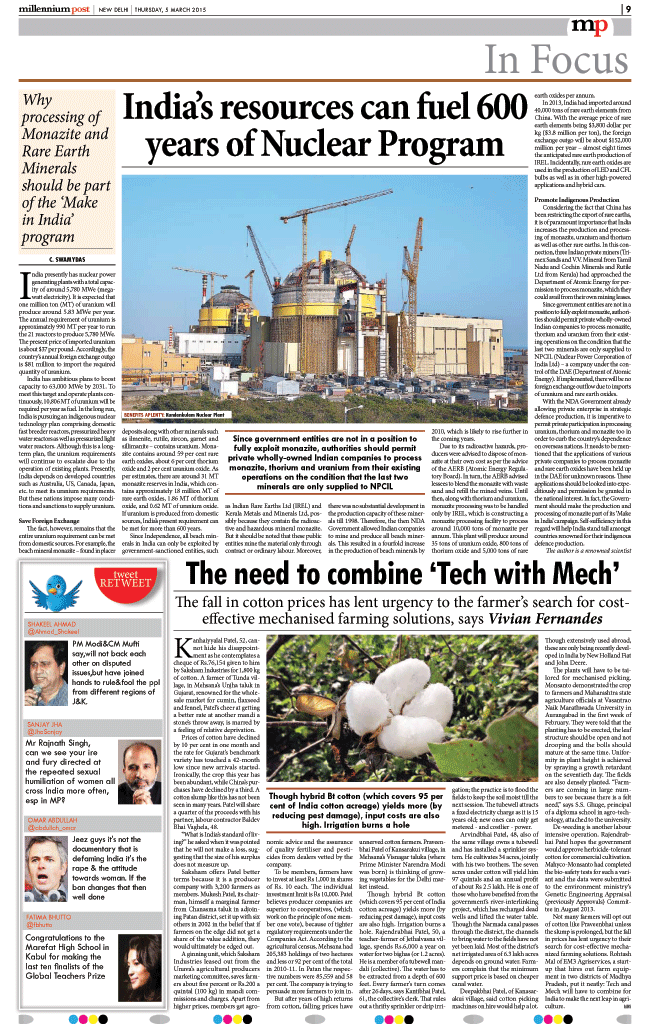
India’s resources can fuel 600 years of Nuclear Program
5 March 2015, New Delhi, C. Swamydas

 Why processing of Monazite and Rare Earth Minerals should be part of the ‘Make in India’ program.

India presently has nuclear power generating plants with a total capacity of around 5,780 MWe (megawatt electricity). It is expected that one million ton (MT) of uranium will produce around 5.83 MWe per year. The annual requirement of uranium is approximately 990 MT per year to run the 21 reactors to produce 5,780 MWe. The present price of imported uranium is about $37 per pound. Accordingly, the country’s annual foreign exchange outgo is $81 million to import the required quantity of uranium.

India has ambitious plans to boost capacity to 63,000 MWe by 2031. To meet this target and operate plants continuously, 10,806 MT of uranium will be required per year as fuel. In the long run, India is pursuing an indigenous nuclear technology plan comprising domestic fast breeder reactors, pressurized heavy water reactors as well as pressurized light water reactors. Although this is a long-term plan, the uranium requirements will continue to escalate due to the operation of existing plants. Presently, India depends on developed countries such as Australia, US, Canada, Japan, etc. to meet its uranium requirements. But these nations impose many conditions and sanctions to supply uranium.

Save Foreign Exchange
The fact, however, remains that the entire uranium requirement can be met from domestic sources. For example, the beach mineral monazite – found in placer deposits along with other minerals such as ilmenite, rutile, zircon, garnet and sillimanite – contains uranium. Monazite contains around 59 per cent rare earth oxides, about 6 per cent thorium oxide and 2 per cent uranium oxide. As per estimates, there are around 31 MT monazite reserves in India, which contains approximately 18 million MT of rare earth oxides, 1.86 MT of thorium oxide, and 0.62 MT of uranium oxide. If uranium is produced from domestic sources, India’s present requirement can be met for more than 600 years.

Since Independence, all beach minerals in India can only be exploited by government-sanctioned entities, such as Indian Rare Earths Ltd (IREL) and Kerala Metals and Minerals Ltd, possibly because they contain the radioactive and hazardous mineral monazite. But it should be noted that these public entities mine the material only through contract or ordinary labour. Moreover, there was no substantial development in the production capacity of these minerals till 1998. Therefore, the then NDA Government allowed Indian companies to mine and produce all beach minerals. This resulted in a fourfold increase in the production of beach minerals by 2010, which is likely to rise further in the coming years.

Due to its radioactive hazards, producers were advised to dispose of monazite at their own cost as per the advice of the AERB (Atomic Energy Regulatory Board). In turn, the AERB advised lessees to blend the monazite with waste sand and refill the mined veins. Until then, along with thorium and uranium, monazite processing was to be handled only by IREL, which is constructing a monazite processing facility to process around 10,000 tons of monazite per annum. This plant will produce around 35 tons of uranium oxide, 800 tons of thorium oxide and 5,000 tons of rare earth oxides per annum.

In 2013, India had imported around 40,000 tons of rare earth elements from China. With the average price of rare earth elements being $3,800 dollar per kg ($3.8 million per ton), the foreign exchange outgo will be about $152,000 million per year – almost eight times the anticipated rare earth production of IREL. Incidentally, rare earth oxides are used in the production of LED and CFL bulbs as well as in other high-powered applications and hybrid cars.

Promote Indigenous Production
Considering the fact that China has been restricting the export of rare earths, it is of paramount importance that India increases the production and processing of monazite, uranium and thorium as well as other rare earths. In this connection, three Indian private miners (Trimex Sands and V.V. Mineral from Tamil Nadu and Cochin Minerals and Rutile Ltd from Kerala) had approached the Department of Atomic Energy for permission to process monazite, which they could avail from their own mining leases.

Since government entities are not in a position to fully exploit monazite, authorities should permit private wholly-owned Indian companies to process monazite, thorium and uranium from their existing operations on the condition that the last two minerals are only supplied to NPCIL (Nuclear Power Corporation of India Ltd) – a company under the control of the DAE (Department of Atomic Energy). If implemented, there will be no foreign exchange outflow due to imports of uranium and rare earth oxides.

With the NDA Government already allowing private enterprise in strategic defence production, it is imperative to permit private participation in processing uranium, thorium and monazite too in order to curb the country’s dependence on overseas nations. It needs to be mentioned that the applications of various private companies to process monazite and rare earth oxides have been held up in the DAE for unknown reasons. These applications should be looked into expeditiously and permission be granted in the national interest. In fact, the Government should make the production and processing of monazite part of its ‘Make in India’ campaign. Self-sufficiency in this regard will help India stand tall amongst countries renowned for their indigenous defence production.

The author is a renowned scientist

Source : http://www.millenniumpost.in/NewsContent.aspx?NID=97261
 

National daily


India Plans to Develop Rare Earth Project with USD72 Million

Indian Rare Earths plans to spend USD 72 million developing a rare earth project with a reserve of roughly 3 million tons, which is likely to help reduce dependency on imports from China .

Indian rare earth industry’s series of new tendencies show that the country, as the world second largest rare earth producer, has decided to raise rare earth output.

India’s rare earth element metal import growth lately indicates domestic demand increase in India . However, China has canceled quotas on tungsten and molybdenum exports, which enables expectations on ease of rare earth export quotas and stimulates India to step up rare earth production.

Insiders say that China’s rare earth output represents over 90% of the global total, and India’s rare earth output increase helps lower dependency on China .


Source : http://www.kitco.com/news/2015-02-13/India-Plans-to-Develop-Rare-Earth-Project-with-USD72mn.html?sitetype=fullsite

India is pressing Japan for transfer of Technology in Rare Earth Industry from Monazite – Economic Times News

India and Japan as the two countries try to revive an earlier agreement to trade in rare earth minerals in an effort to counter China’s global monopoly, sources familiar with the matter told ET.

Apart from differences on pricing, the Indian government is pushing Japan to transfer technology and set up industries in India to use these minerals.


Courtesy : http://articles.economictimes.indiatimes.com/2014-09-03/news/53522845_1_india-and-japan-irel-odisha-sand-complex 


When this is the position, how Economic Times Reporter Sandhya’s Article become True? Definitely Sandhya’s report is motivated. 

MONAZITE IS NOT USED IN DEFENSE PURPOSE. BUT USED ONLY FOR PRODUCTION OF LED, CFL PULPS AND OTHER HIGH POWER APPLICATIONS AND HYPRID CARS. THE ECONOMIC TIMES SANDHYA’S ARTICLE IS FALSE.

INDIA RAMPS UP RARE EARTHS PRODUCTION TO MEET CHINESE CHALLENGE

In the wake of China’s growing global dominance over rare earth supplies, increasing supplies by India would be good news for countries like Japan, which have been trying to get rid of dependence on China for imports Several countries, including India, are beginning to tap into their rare earths reserves to ensure a steady supply and reduce the monopoly of China in the rare earths market.

 China’s dominance of the rare earths metals, key ingredients in the manufacture of a host of items from LED lights to smartphones to missiles, has gained much attention in the recent years. Concerns were partly addressed this month, when China removed some restrictions on rare earths exports following an order by the World Trade Organisation (WTO) last year.

 Experts say that the ruling has resulted in a sharp fall in rare earths prices in the international market. Dr. M.L.P. Reddy, Chief Scientist & Head, Materials Sciences & Technology Division, Council of Scientific & Industrial Research, India, told The Dollar Business, “China’s restrictions on rare earths were mainly intended to increase international prices and create a larger demand for its exports. However, the international prices for the rare earths have come down sharply, following the WTO ruling on China.”

 Dr. Reddy said that China will have to remove more restrictions on rare earths production and exports to maintain its place in the world rare earths market. However, several countries continue to look for alternative sources such as India.

 India is the second largest producer of rare earths with an annual production capacity of 2,800 tonnes, much below China’s 105,000 tonnes but ahead of Australia, Brazil and Malaysia which also produce rare earths. However, with its estimated reserves of over 3 million tonnes of rare earths, there is a huge potential for India to increase domestic production and become self-sufficient in the sector in future, said Dr. Reddy.

Dr. Reddy added that India’s reliance on rare earth imports has grown in recent years, partly due to natural calamities in rare earths producing areas, but production is expected to increase in the coming months. Dependency on China for rare earth imports will also come down, as several nations like USA, Australia, Malaysia, Singapore, and India are planning to increase production, he said.

Indian Rare Earths Limited (IREL) is planning to set up a plant in Odisha by October 2015, with which India’s production of rare earths such as monazite and xenotime is expected to increase by up to 5,000 tonnes per year and increase India’s supplies in the international market by around 5%.

IREL, in collaboration with Japan’s Toyota Tsusho company, is also planning to set up a plant in Visakhapatnam for the production of mixed rare earth materials from uranium and thorium ores, which Toyota Tsusho will use to produce neodymium for electric and hybrid cars, as well as lanthanum, cerium and praseodymium. This will further increase India’s rare earths production by about 2,000 tonnes to 2,300 tonnes annually, according to sources.

 According to Dr. Reddy, higher production is expected to make Indian rare earths competitive in the international markets, particularly in neodymium, the rare earth metal used in high power applications and laser manufacturing. He hopes that India will also become self-reliant in rare earths used to manufacture LED/CFL bulbs which the Indian government of India has been promoting to address power shortages in the country.

 Link :  https://www.thedollarbusiness.com/india-ramps-up-rare-earths-production-to-meet-chinese-challenge/ 

Uranium can be produced from Various items – IAEA Report reveals the fact

Sea water is the source for Uranium – German, Italy, Japan, UK,USA are producing Uranium from the sea water.

Uranium recovery from tailings and coal ash also possible (Page 37 of Uranium 2014 : Resources Production and Demand).

Link : http://www.oecd-nea.org/ndd/pubs/2014/7209-uranium-2014.pdf


India’s air traffic grows, IATA credits new ‘supportive’ government

New Delhi: Reflecting ‘solid’ growth over the past two months, India’s domestic passenger traffic rose 7.4 per cent in August, recording the second highest growth rate globally after Russia’s 10 per cent, latest IATA data shows. “Indian domestic demand climbed 7.4 per cent. Results for   the last two months have been solid, perhaps an early sign of   improvement as a result of the new business-supportive government regime,” the analysis of the data by the   International Air Transport Association (IATA) said.

India’s domestic Revenue Passenger Kilometers (RPK), which measures actual passenger traffic, grew 7.4 per cent over August last year, almost matching the 7.6 per cent rise   in Available Seat Kilometres (ASK) that indicates available   passenger capacity or the number of aircraft seats available. The overall average domestic demand rose 4.5 per cent in August compared to August 2013 with all markets reporting   growth, led by Russia and India, the analysis said.   Like India, Russia’s high growth rate of 10.1 per cent   showed that the airlines there “have been able to stimulate domestic demand through significant fare reductions”, it said.

The international air traffic results showed a “slight   pick-up in demand” in August over the previous month. Airlines in the Asia Pacific region saw their global   traffic rise 5.8 per cent in August compared to the previous year.

While seat capacity rose by seven per cent, their load factor declined 0.9 percentage points to 81 per cent.Middle East region saw the strongest year-on-year traffic   growth at 11.7 per cent as airlines there continued to  ‘benefit from the strength of regional economies and solid growth in business-related premium travel’.  Commenting on the air traffic data, IATA Director General   and CEO Tony Tyler said, “August was a good month right across the industry. All regions reported an expansion in demand for   air travel” with high load factors.

“We should, however, keep an eye on potential downside risks,” he said pointing towards European continent’s ‘increasingly worrying economic outlook’.


Link :


http://www.deccanchronicle.com/141003/business-latest/article/indias-air-traffic-grows-iata-credits-new-supportive-government

Nod for Extra Mining in Indian Ocean Bed

In line with its efforts to expand its footprint in the strategically important Indian Ocean, India has got a go-ahead from the International Seabed Authority (ISA) for exploration of minerals in another 10,000 sq km area in the South-West Indian Ocean. Continue reading “Nod for Extra Mining in Indian Ocean Bed”